


Pucón is dead. It is a quarter hour before six in the morning. We are the first people at the guiding company. The door is locked, so we sit on the steps and wait outside, on the quiet, dark street. The town will wake in three hours when the tourists flood the local restaurants for breakfast, then boutiques for souvenirs. By then, we will be on the slopes of the volcano.
Alex was unsure about this adventure. We are not mountaineers. The biggest hill we climbed last year was a set of eighty steps to our friends’ home on the islands of Bocas Del Toro. But Villarrica is tall. The Chilean stratovolcano erupts from the plains around the eponymous lake and steeply climbs to 2,860 meters (~7500 feet). The still active, at times smoking, volcano is covered in snow. It does not look well-disposed to interlopers.
But we are fit enough, I say. We routinely hike ten miles on the weekends in the heat. The slopes will be tough on the thighs. Yes. But we have the aerobic engine to push on. We will make it. Alex concedes, and we sign up for the ascent.
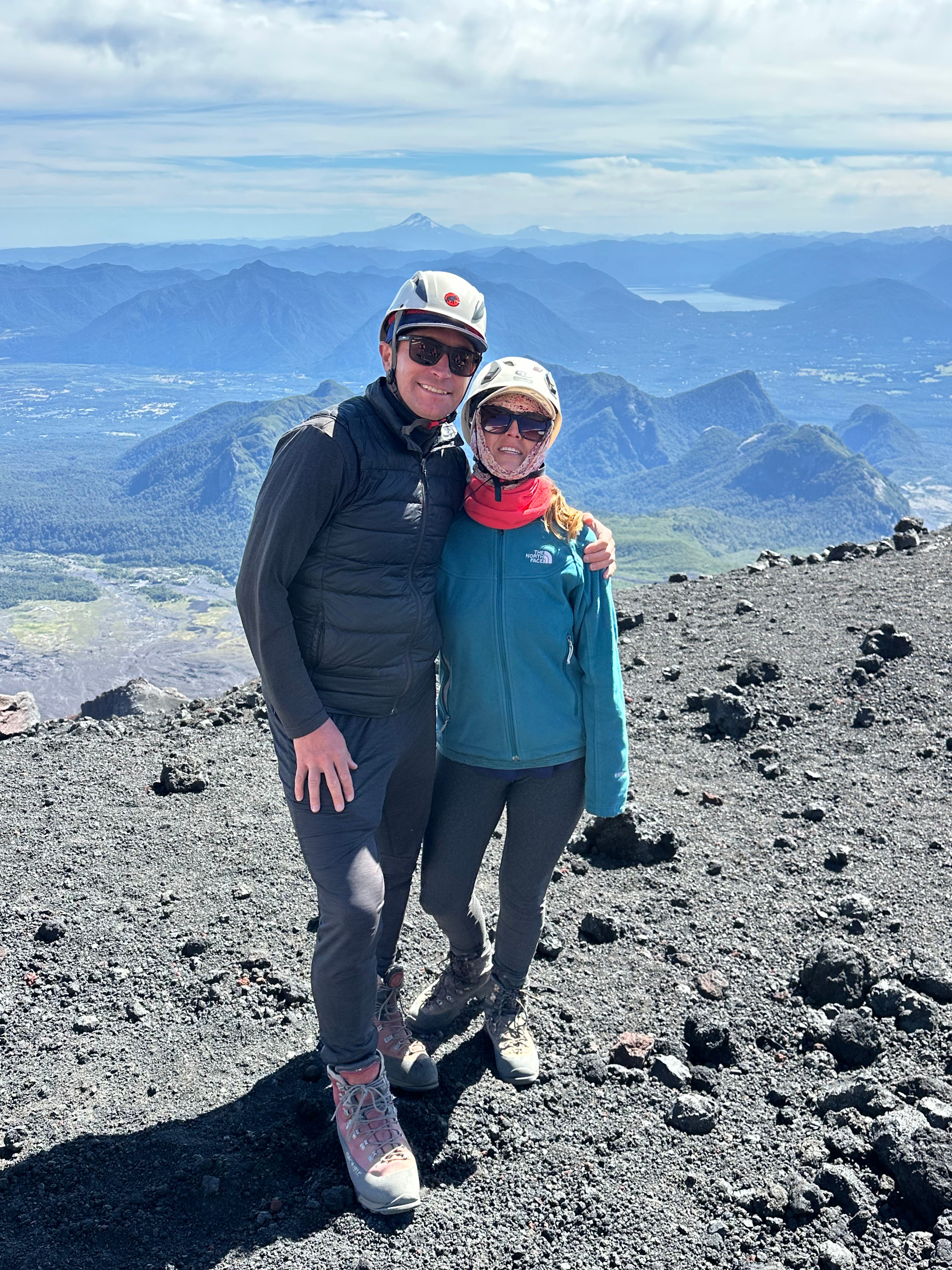
Soon, the other eight people are here. We inspect our backpacks: crampons, ice axe, snow pants and jackets, a plastic sled for the ride down, gloves, helmets, sunglasses, gas masks for the caldera. We put on the climbing boots, stiff and heavy, then load into the van.
At the base of the volcano, the guides break us into groups. Each issues instructions to their small team. We’ll go slowly and steadily, our guide tells us. We’ll take a few breaks to rest, take our packs off, drink, and have a snack. The crampons are for the snow, but don’t worry about it now, he says. After the instructions, we head up.
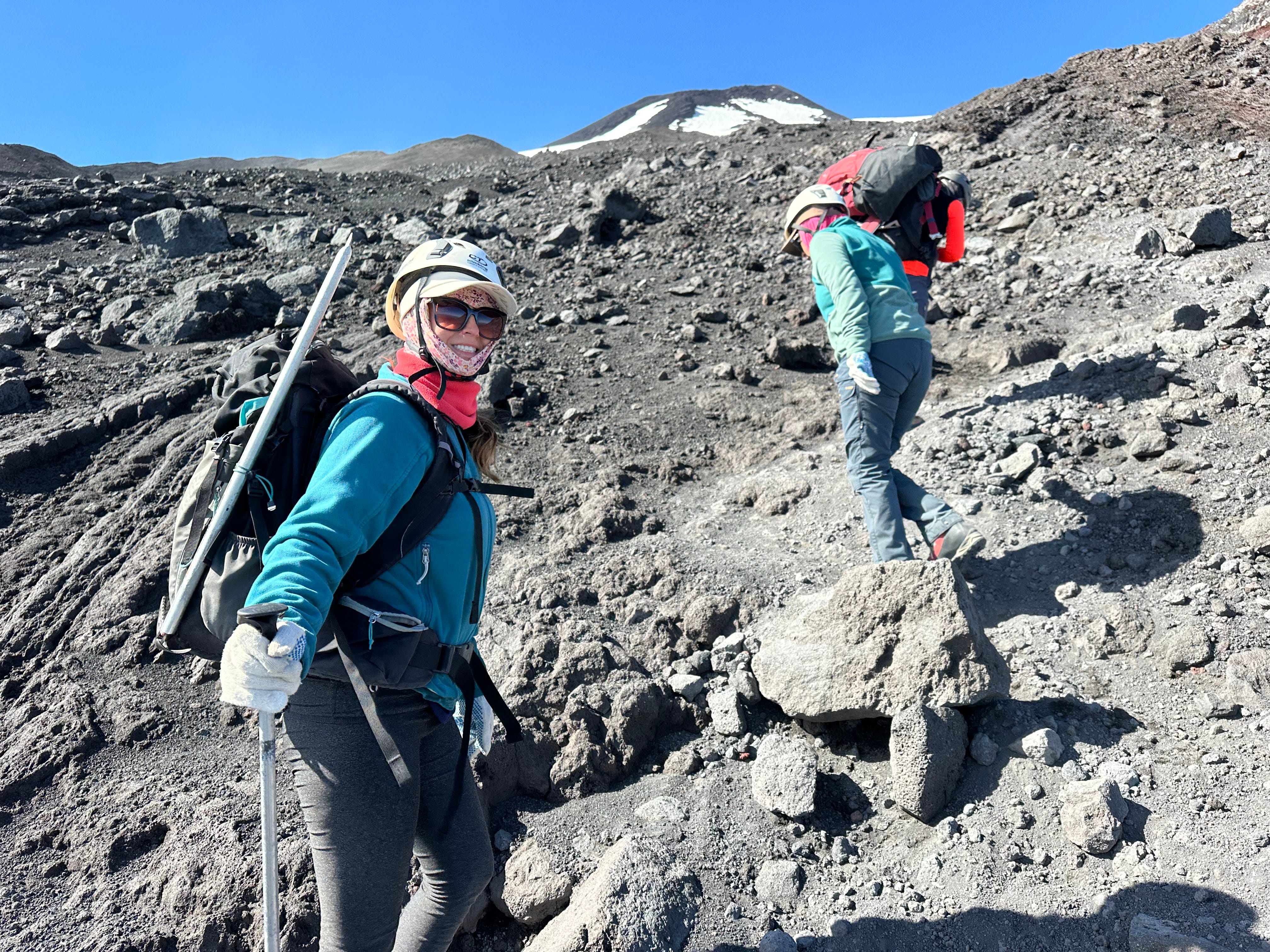
The pace is high. The first kilometers are on the gentler slopes. It is a steady uphill on a rugged trail through the thinning trees. After half an hour, we stop to shed layers, too warm from the effort. The cold air is a respite. In another half an hour, we begin the climb.
It is steep. The trail switchbacks among rocky outcroppings. The surface is mostly firm, but sections are the soft aggregate of volcanic pebbles that capture the sinking boots and send us a step downslope for every few steps up. I look back. We climbed above the plains and the trees, and can already see the vistas for tens of kilometers into the distance. Seems like good progress. I lift my head up to see how much further I have to go. The top is as far away as when we started.
Villarrica is one of the 65 active volcanoes in Chile. Other accounts claim there are 62, others over 90. The total number of mostly extinct volcanoes in Chile is about 2000. The number of active volcanoes depends on the definition of an active volcano. Some counts include the mountains with recent eruptions, which are still seismically active today. Others, relax the definition to include the volcanoes that erupted within the time of human history, and still have a chance to blow in the future.
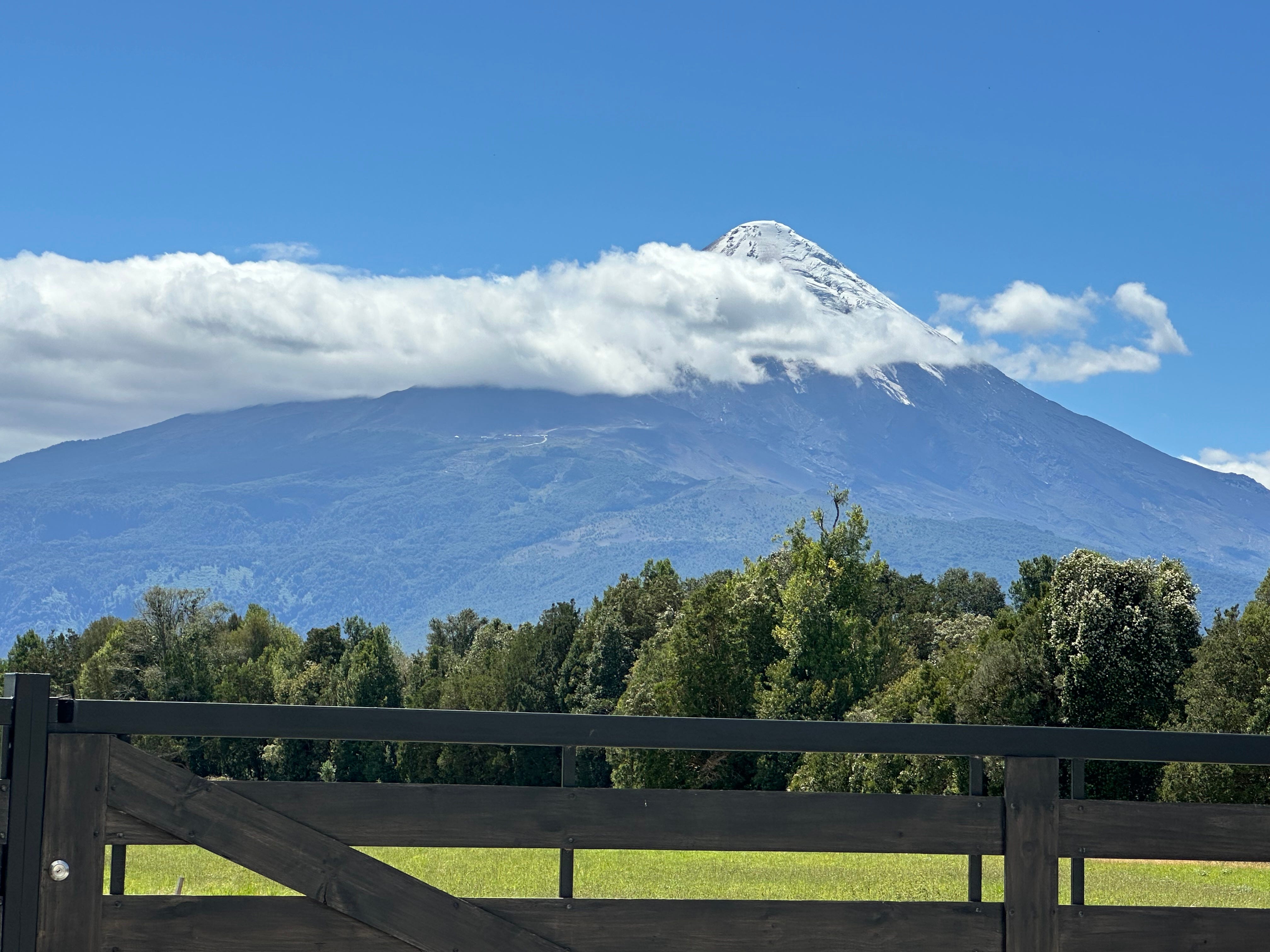
Villarrica is from the former group of sixty volcanoes actively monitored today. It is one of the most active volcanoes in Chile. The last eruption occurred in 2015. The spewing lava fountains and ash columns force the evacuation of Pucón and other neighboring villages.
In the years since, the volcano has been quiet. It puffs smoke at times, hence our gas masks, and other times the lava bubbles to the top and pools in the caldera, visible from the rim of the mountain at night as a soft glowing lake of molten rock. The lava lake is almost always there, but it fluctuates: rises with the buildup of gases, then recedes a hundred meters below the mark near the rim in the calmer periods of weeks or months.
An hour and a half into the climb, the pace is relentless. I look at Alex and see her despair. She shakes her head. I don’t think I will make it, she says. Her quads are already dead. I nod. Mine too. No worries, I say, you may catch a second wind after the breakfast stop. She shakes her head with doubt.
But I have been there when I ran mountain ultra races. In each, the trouble came a third into a race. The mind responded to the rebelling muscles and commanded a full stop. You won’t make it, it would say. I’d think about two-thirds of the race still ahead, assess my body, and see no way how I could run another hundred kilometers. But at the next aid station with chicken soup, Gatorade, and smiling people, something would flip, I’d run on feeling well. After the finish line, I’d think with surprise how I could put one foot in front of the other in that miserable stretch one hundred kilometers ago.
This is one of those moments for both of us. There is no way we can make it. But it is the wrong time to stop. So we climb on. One foot in front of the other, sliding back every fifth step.
Alex is in front of me. She rounds the corner on a narrow ledge, then the fifty-kilometer-an-hour wind pushes her sideways, and she teeters on the path. I grab her backpack. But she is fine. I am just nervous. The wind is relentless. Angry.
It is Puelche, our guide tells us. This wind blows from Argentina. It crosses the Andes and descends the steep Cordillera, compressing and warming in obeisance to physics. It is a warm wind. Pleasant when you stop. Brutal when you push against it.
The Puelche will stop above 2400 meters near the top, the guide tells us. The wind detaches from the steep cone of the volcano to rush towards the Pacific on its rampage. I hope so, I say. The wind is loud and terrifying when I am walking on a ledge.
We take another break in a gulch between two outcroppings. The view is stunning, but we hardly glimpse. The people with us add a layer of pants. We put on the helmets. Then we are off again.
Another break. This one is beyond the last black diamond chairlift. Closer to the high snow. I look at Alex. A tear is running down her cheek. I don’t think I can make the summit, she says, sorry. I touch her shoulder.
The guide sees it too. He asks how she feels. Alex is honest. He nods. This is the point where people make a decision to stop and where he expects the group to thin. He asks me if I plan to push on, but I say I am staying here. He says I should come with him. But I shake my head. This is our trip. Alex’s and mine. What is another summit without your person?
A filled checkmark, empty of meaning.
We work together with other guides, our guide says, so you can go with her. He points to a young woman. Her face is tanned, happy, with indigenous features. It will be you and a couple of others, he says. Then he leaves with the fragment of our first group.
“I am sorry you won’t reach the summit,” I tell the new guide.
She smiles, “No need for me to go up there. I am Andréa. It is about you and you and you.” The statement is simple. Honest. I believe she means exactly what she says.
“There is a great view around that ridge on the way to the summit,” she points up where the volcano disappears past the steep slope. “We can slowly climb to see it. At our own pace, when we are ready. She polls our small group, and we all nod. But we rest first.
We sit. We chat. We hoist the backpacks, adjust the balaclavas, and start to trudge up the serpentine slope. Step after short step. It is easier without the pressure of reaching the summit. I look at Alex on a switchback, and she smiles for the first time since the bottom.
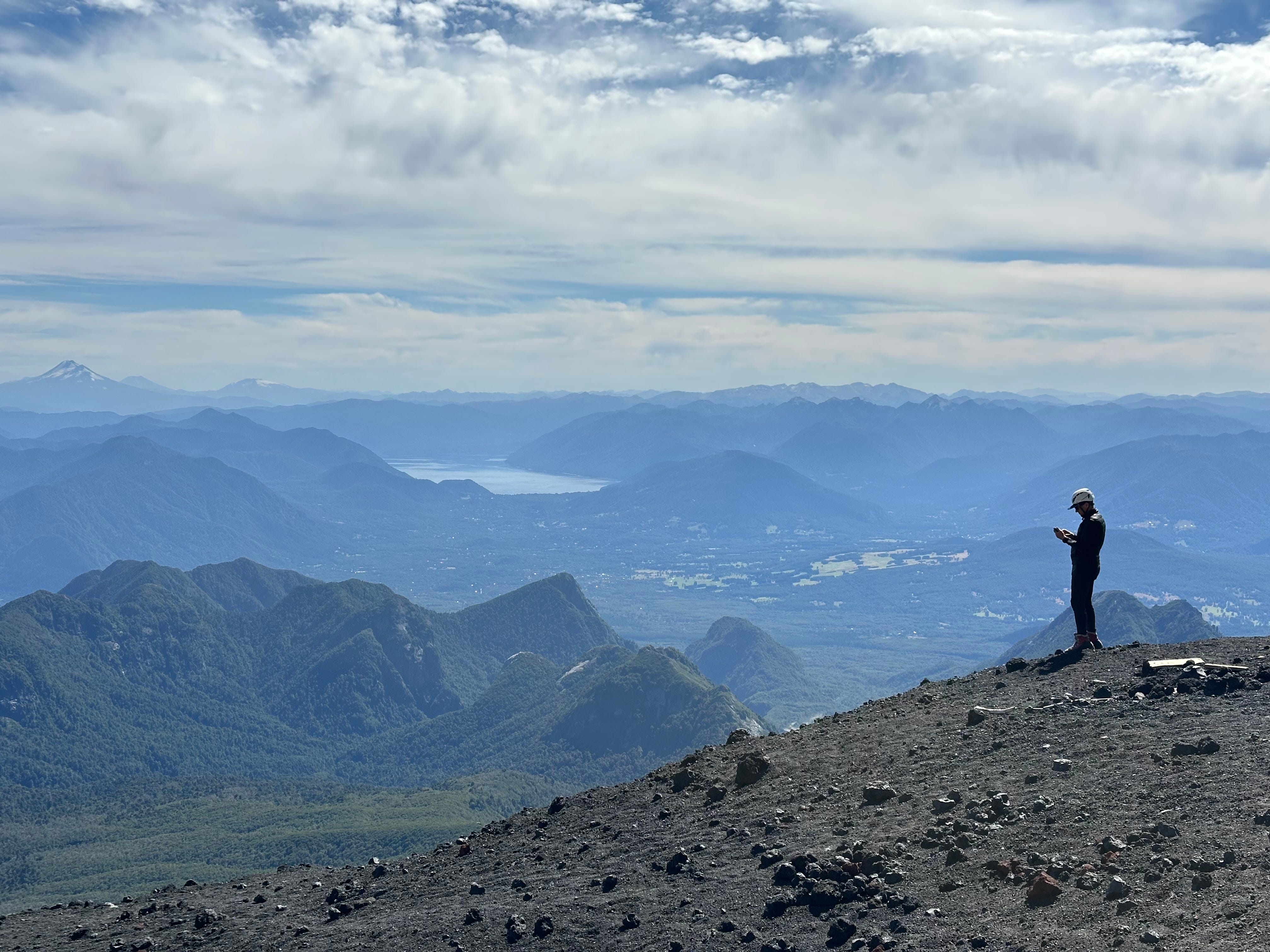
The view opens to 270 degrees on the ridge. We see the small, map-like imprint of Pucón on the landscape below. The view beyond stretches for a hundred kilometers. The steep mountains that surrounded the city yesterday are only small hills from our vantage point on the stratovolcano. We laugh, then sit for some time to take in the new perspective.
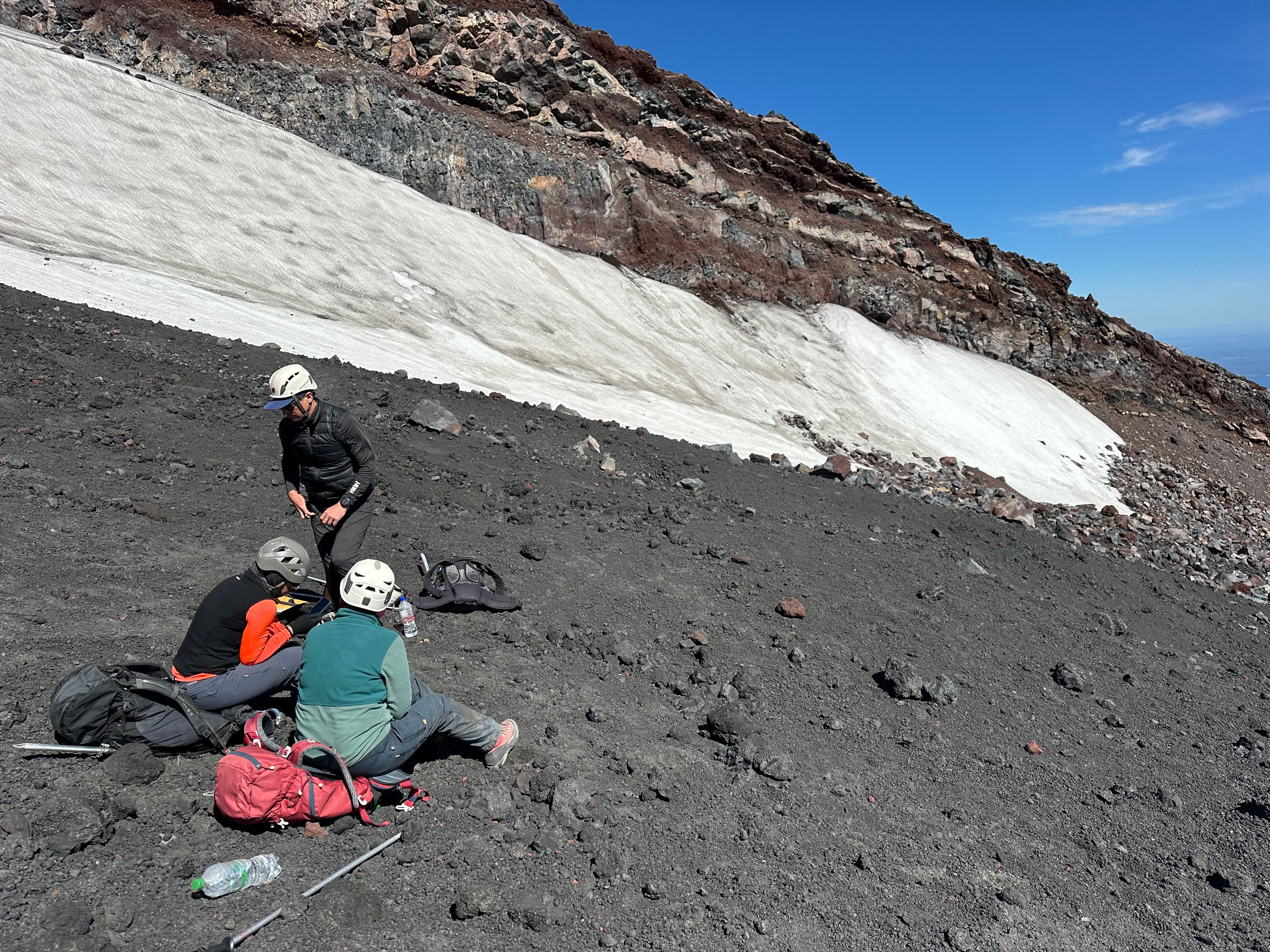
Andréa walks over, with a booklet of birds, and tells us which ones live on this volcano. Her eyes widen, and she points to a bird from a page hopping on the rocks next to us. It is a rare kind. It is small and white, with a yellow line from the beak to the wing. Andrea is surprised to see it. I am surprised such a small bird can sit on the rock in the howling wind.
We pick up our packs and climb again. A concrete structure is to our right. It is robust, with an arched dome and open front, like a tube half-buried into the mountain. The opening is facing Pucón and away from the caldera above. A shelter. During the eruption, Andréa says, the lava accelerates on the snow, collects the rocks, then rushes down the slope towards Pucón at 60 kilometers per hour. It flows around the shelter.
I see the evidence of the flow, but I can’t make sense of why someone would be up here during the time of eruption. Scientists? Researchers? A few lunatic mountaineers? Or maybe something was lost in translation, and I simply misunderstood?
We are climbing to a ledge one hundred meters above. I see one of our companions ahead without a backpack. The backpack is on Andréa’s back, slung on top of her own. It does not slow her down.
The wind stops in line with the snow, just below the ledge. We climb over and sit on the rocks. It is as high as we go, Andréa says, we will descend from here.
I look up at the summit. It is right there, another few hundred meters. A group is traversing across the snow on their final stretch to the summit. I expect a flood of regret, but it does not come. Equanimity settles instead. When did it happen, when the youthful urge to achieve ceded to the contentment with the journey? Ten years ago, or five. It marked a time when more things became joyful.
Alex pulls empanadas out of my backpack. We bought too many, and they are enormous. We offer them to Andréa and others. They share one. We have one each. Real food is inconvenient on hikes and climbs, but it lifts spirits beyond what a protein bar can do.
Andréa points out volcanoes in front of us. Lonquimay, where we were a week ago. Llaima and Osorno. Calbuco is a bit behind us, at the edge of Puerto Montt. Each is a white colossus rising above the mountains and among the lakes. Their size plays tricks with distance. The symmetrical snow cones are just in front of us, but hours of driving away from each other.
Two people slide on the snow from the summit towards us. They arrest the slide with crampons at the edge of the snow, and repack their flat sleds and crampons into backpacks, then head down. They are a couple who climb as a hobby. They zoomed past us on the ascent. Now they are in a hurry to get down. We pick up our gear and follow.
We take a different route down through the lapilli field. Lapilli or scoria is loose volcanic rock fragments, pea- to walnut-sized. Andrea shows the technique, then I follow. I gently push away from the slope and let the gravity guide my hop. The foot lands, buries in soft lapilli, then slides down a bit more. Then another step in a rhythm of moon hops, long and slow. It is fun! We move five times the speed of our climb. Or faster.
At the bottom, my thighs are burning. Knees wine from the pressure of repeated, albeit soft landings. But I am exhilarated. Alex is smiling too. We walk the last two kilometers through the woods on lighter feet. We did not complete the climb but we did what we set up to accomplish. Something difficult that we have never tried together.
If you enjoyed the story, please Like and Restack. It helps us reach new readers. Thank you.
Oh boy, I agree with Darren. Alex you were a very good sport! Egor you were the perfect person for her to do this outstanding sport with! Love you both. G'ma
Wow! What an amazing adventure. It's all about the journey and not the destination. Too many people push themselves too hard and regret it. This is such a well-written story - not only about the climb but about the lessons you learned along the way.