


We walk by a small group of sailors around the fire. We say hello and smile at them, but do not stop on the way to our dinghy.
“Hey,” a man calls after we pass, then rushes after me. He is a tad older than me, fit, with a white beard, well-trimmed beard, and only a lightly tanned face under the soft-brimmed hat. “Do you spear fish?” He asks. His accent is Germanic but faint.
His question stumps me. It is without preamble or context.
He extends his hand. “I am Yakob.”
I shake the hand and suppress my instinctive suspicion.
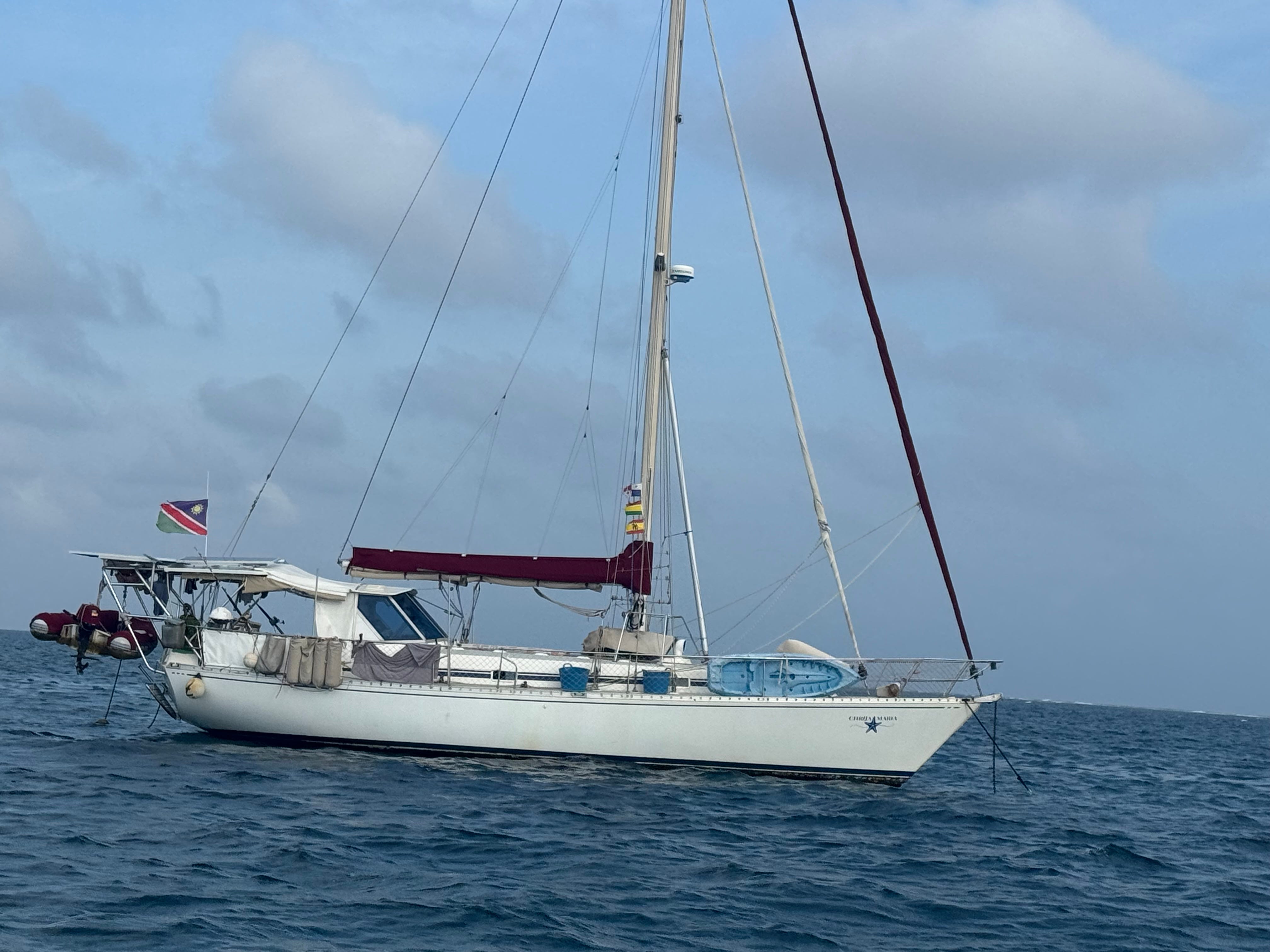
“Are you our neighbor on the boat with the Namibian flag?” I ask.
“You know the flag?”
“I looked it up.”
“My wife and I are from Namibia. She hates it when I go spearfishing alone. So I always look for company.”
“I do,” I answer his first question, “but don’t have a speargun with me, only a pole spear.”
“I have an extra you could use.”
“Would love to go,” I say.
“I will drop by around nine tomorrow morning to make a plan. The cut in the reef I like works best in high tide,” he says.
He comes at two the next afternoon.
“You want to go at three?” He asks. “Sorry, I didn’t feel great this morning and had to take it slow.”
“Three is great.”
I pull out my blue camo diving pants and the hooded top with a rubber pad centered on the chest. It is for resting the butt of the speargun when reloading the bungees. I check my mask, snorkel, and the long free-diving fins. I load my weight belt with five kilos and slide on the diving knife. The mask defogger goes into the weight bag.
Yakob picks me up on time. His dinghy is small, but there is room for my gear and my feet atop the anchor chain. He tells me about the cut we will explore and our plan for the dive.
“The speargun you will use does not have a reel and a float,” he hands me the gun. “Don’t shoot anything so big that you can’t hold onto.”
We put defogger on our masks and dive overboard. The water is clear. I can see past sixty feet into the cut. The current is less than a quarter knot. It is pushing me past the enormous coral fans just below, but I counter the current with the easy stroke of my fins.
These reefs form a submerged wall, five kilometers wide. They are unseen from a distance but insinuated by a stretch of dangerous waves breaking against the coral walls on the ocean side.
On the navigation charts, they are depicted as jagged green patches. The zigzag edges are meant to convey the uncertainty of the boundaries and the extreme danger to boats. The danger that kills ships.
On the bay side, the reefs subdue the swell and turn the ocean to placid calmness. The water assumes a range of azure shades that tell a story of topography and life below the surface. The deep blue patches are the deeper holes. The greenish dark sections are the seagrass fields. The beautiful light azure is the sand. You have seen it on postcards.
It is the bands of underwater sand that we fish.
We swim a quarter kilometer against the current up the side channel. Cold flows brush against my face. It is the water lifted from the deep by a recent upwelling. The depth by the reef is only ten meters, but a kilometer deep a short distance from here. Spooky dark, and cold.
These corals are an escarpment of life. Fish. Bright coral heads. A sea turtle is dashing away. A nurse shark ten meters below is lying on the bottom in wait. Another nurse shark glides through a cut and follows me twenty feet behind, then closer, then closer still.
A nurse shark will not harm me, even at seven feet long, but the slow pursuit by a vestigial predator is unnerving. I am prey, and my mind fills with fear. I slow down and poke the tip of my spear in the direction of the shark’s nose. I don’t intend to poke it, I am too far, but my slowing down makes the predator weave and leave.
I look up and see Yakob watching me. I sense he is smiling, but I can’t tell past his snorkel. He turns and swims around the top of the reef towards the cut where we are going to fish.
I stop kicking and let my body relax. We are drifting on the current now. It is time to slow the heart down and breathe deeply to oxygenate the blood. It is a simple task of doing nothing, but the mind does not go along. It worries about the dive time, the weights, spotting the fish, my aim. I tell myself to relax, but instead tighten my chest and breathe in shallow spurts that ruin the rhythm.
After a break from diving, my mind forgets what my body knows, and I know better than to fight it. I need two dives for the old instinct to return and soothe the beating heart to a slower rhythm.
I inhale and glide towards the bottom. The adrenaline rushes my movements, and I burn through the air in seconds. I float back up.
I am slower on the second dive. I creep along the bottom and peek around the coral head into a narrow gulch. Nothing there but two blue tangs. They are a gorgeous, shimmering-blue fish, always darting, nipping at algae on the rocks. Big fish in profile, but thin like a plate from the front. They are not for catching. They carry a high risk of ciguatera toxin, which is the misery I do not want. I watch them go left, right, then vanish.
On my third dive, I am at the bottom holding onto a rock. My heart is beating slower. Oxygen consumption drops. I can function for longer in the depth. It is an old instinct we mammals borrowed from the earlier branches of the evolutionary tree to give us a fighting chance against the hostility of water. Or, maybe it goes older still, to the time of amphibians, when holding a breath was just a thing to do.
I push off the bottom and slowly kick up to a depth where the buoyancy returns, and my expanding lungs and wetsuit pull me up to the surface. I love the transition from sinking to floating. It is otherworldly, that trade between states of heavy and light. Like a mood, but the one I can control.
I breathe through a snorkel on the surface, with my face down. Yakob is at the edge of the sand below me, creeping around a coral head, then he swings the speargun at something I don’t see. The shaft flies. I follow the streak and see the shaft bury itself into the sand. Then a grouper twists and darts away. A miss.
I am next on the prowl. A shadow is moving my way, silver and narrow with a serrated tail. Spanish mackerel. I still myself behind a rock, knees on the sand, both hands on the speargun. Now, I am part of the coral, and little fish swarm me and bump into my mask.
I have been at the bottom for two minutes and begin to feel the tightening in my chest. The growing spasms of the body warn me that the level of carbon dioxide is reaching a dangerous threshold. Without practice, this feeling turns into panic and sends us scrambling for the surface. It is the compulsion to breathe. But it always comes early. The body still has another minute of reserves.
Free divers learn to handle it, wait through it, until the spasms recede. They will come again and soon, but the break buys me time to wait out the mackerel.
It is coming my way.
I am still.
I watch the silver predator through the swarm of small fish in front of my mask. The mackerel’s serrated tail slices the water, pushing it towards me.
But then it turns. Still four meters away. The distance is within the range of the roller gun, but I hesitate too long. I am too slow to follow it with the shaft, but too fast for it to notice. So it darts across the trench, and I take my finger off the trigger. I am not good enough to match its speed.
We dive for another hour. But an encounter with a pelagic is the highlight, so we soon give up and kick our way to the dinghy.
“Beautiful,” I say for the first time in an hour and a half.
“Did you see the yellowtail snapper?” Yakob stores the fins and the mask at the back.
“No. Saw the grouper you went after.”
“I was too close to him when trying to set up. He spooked,” he shrugs.
“I am just utterly out of practice,” I say.
We slowly motor back in the lee of the loud reef. He tells me how he finds his fishing spots, and I take note. Then he raises his free hand.
“There are people who live on the sea,” He points at me and himself. “And there are those who visit. You know, the charters. There are spots they go to fish and to have their fun. They have a right. But, we have a right to keep a few secrets.”
He swears me to secrecy. I nod.
I ask about his journey from Namibia, and he tells me a brief and simple story. He left, but Namibia is still home. He is going back there in two months. But only to visit, never to stay.
I recall the suspicion with which I met his first approach. Nothing about him but me. I am distrustful. A personal defect most times, except when it saves it. I am glad I put it aside yesterday.
Alex and I leave the island chain the next morning. Yakob is not on the boat. He and his wife are walking their dogs on the beach. It feels odd to depart without leaving a thank you. I’ll keep an eye out for the Namibian flag.
If you like the story, please Like and Restack, it is the best way to help us reach new readers. Thank you!