


We are currently sailing from Bocas del Toro, Panamá to Cartagena, Colombia, through the Guna Yala archipelago. This and the following few posts are from places where we stop for a few days at a time.
We are one of the few anchored sailboats in the bay. Silent cayucos - indigenous dugout canoes - are the only other craft in a loose pack at the edge of the clear blue hole. A fisherman in each pulls on the line hand-over-hand, tosses the fish on the floor at his feet, then throws the hook in the water again. Portobelo is tranquil. Quiet.
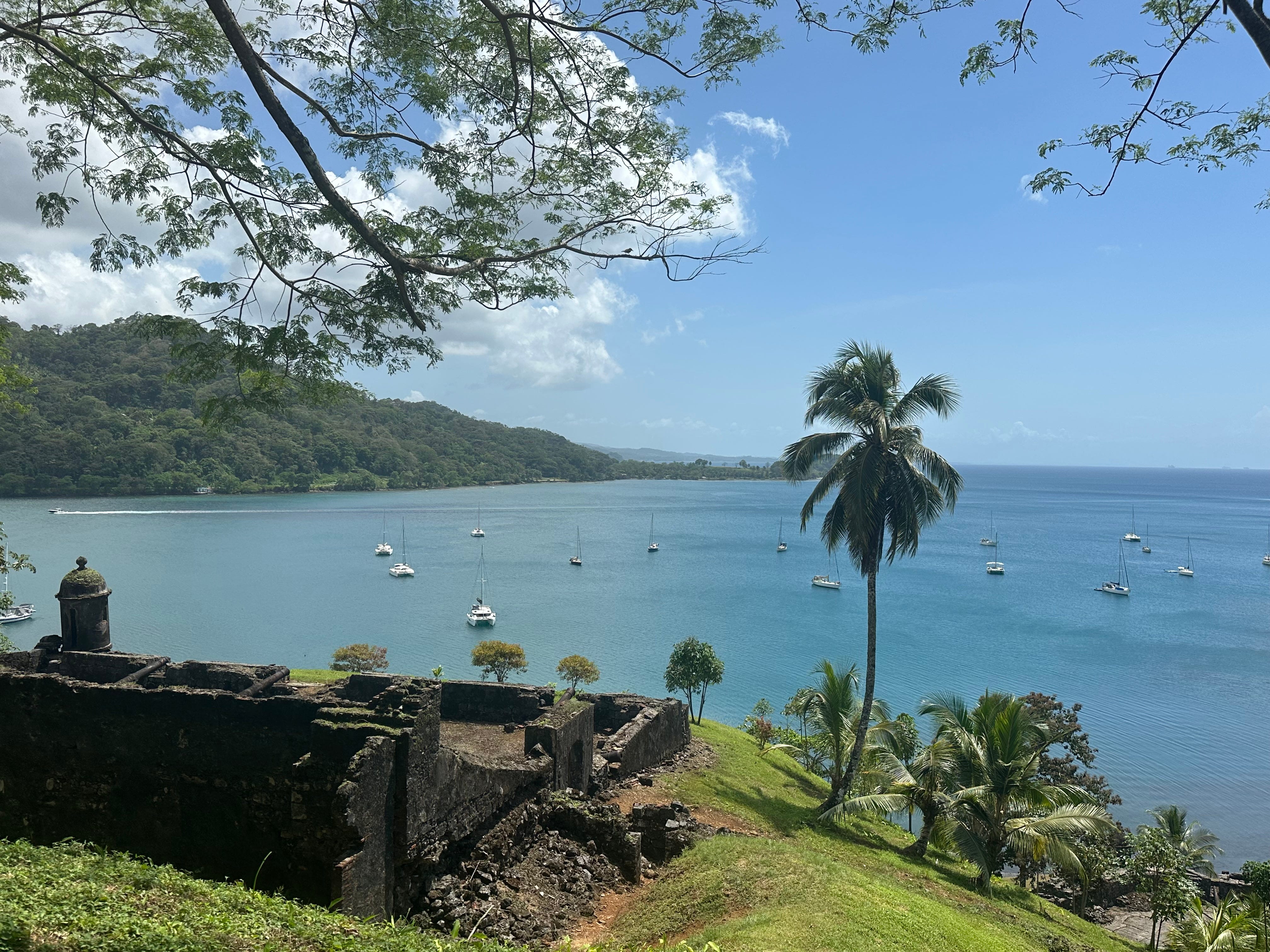
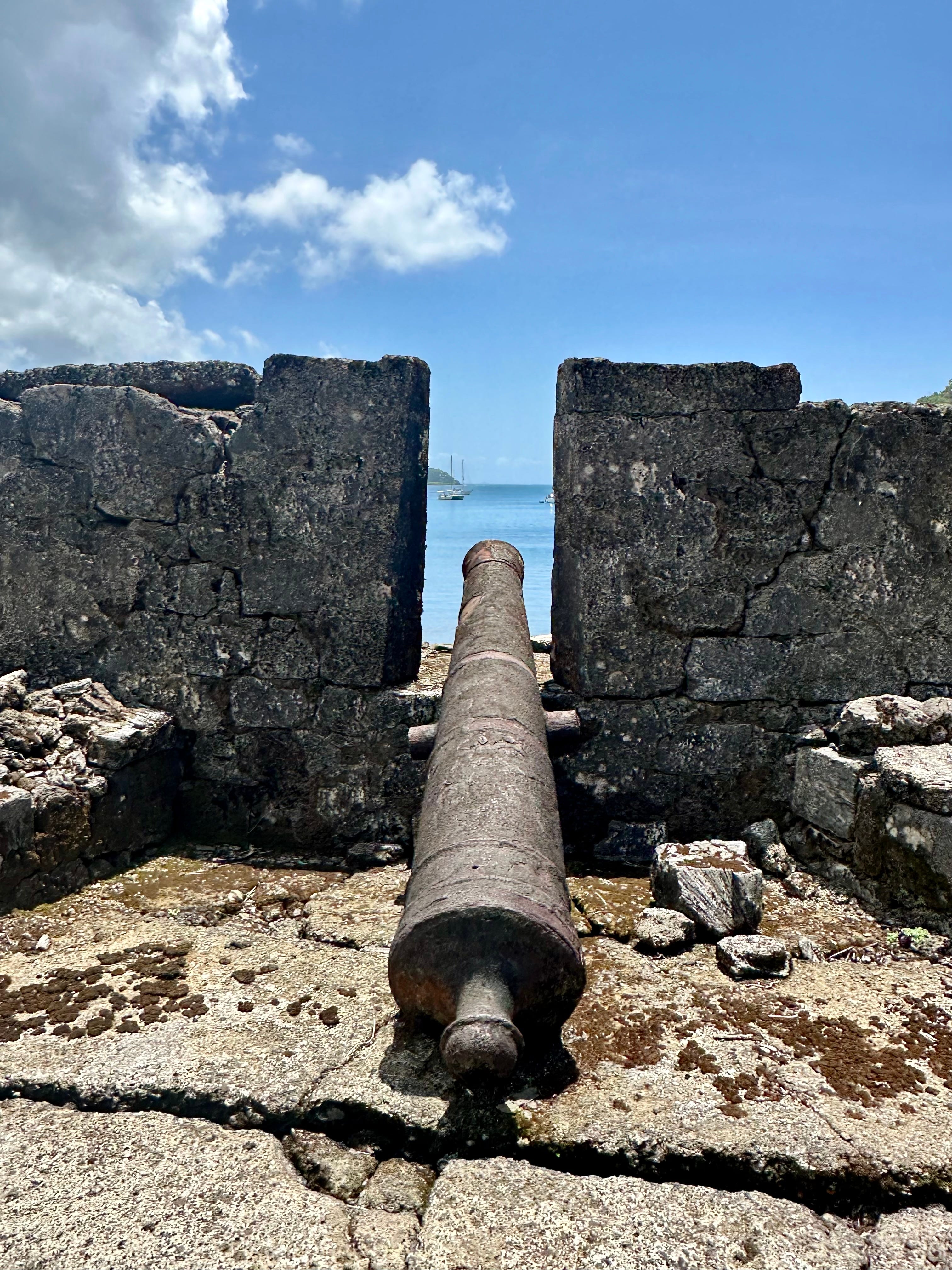
Yet, this silence is new, a century old. Portobelo, Panama had a noisy history of changing fortunes, pirate victories, and pillaging empires. I see a reminder of old upheavals in thirty cannons trained on our boat from the ruined walls of three forts on shore and in the hills. Even from the distance, disused for centuries, their dark muzzles in the embrasures send a chill through me.
For a week now, every morning, I sit with my coffee at the bow of the boat, studying the gray coral walls of the forts. I look at the old guns looking at me. Why are they here? I don’t know this history, so I read.
It began with a promise. There is gold to the West, Columbus pitched the Spanish Empire. The Spanish found it after a century of voyages. Ships laden with stolen Peruvian treasure offloaded their loot on the Pacific side of Panama onto land caravans. The mules, people, and chains hauled it across the narrow spine of the mountainous isthmus to Portobelo, in the Caribbean. This protected bay became the base where the traders bought and loaded the treasure onto massive armadas for transport to Spain, to the descendants of Queen Isabella and King Ferdinand.
Where there was gold, there were pirates. Hence the guns.
The dog jumps into the dinghy and posts himself at the front. He hangs over the inflatable tube, his paws are over the edge, and his long face leads us to shore, like the bowsprit figurehead of the old ships, but alive. His ears are flapping in the wind.
The beach sand is jet black. It is the pulverized volcanic rock washed up here from inland streams. The dog jumps onto black sand, bounds over the coral rocks, and disappears into restored remains of the San Felipe fort. He knows the way, we walked through it each day of the past week.
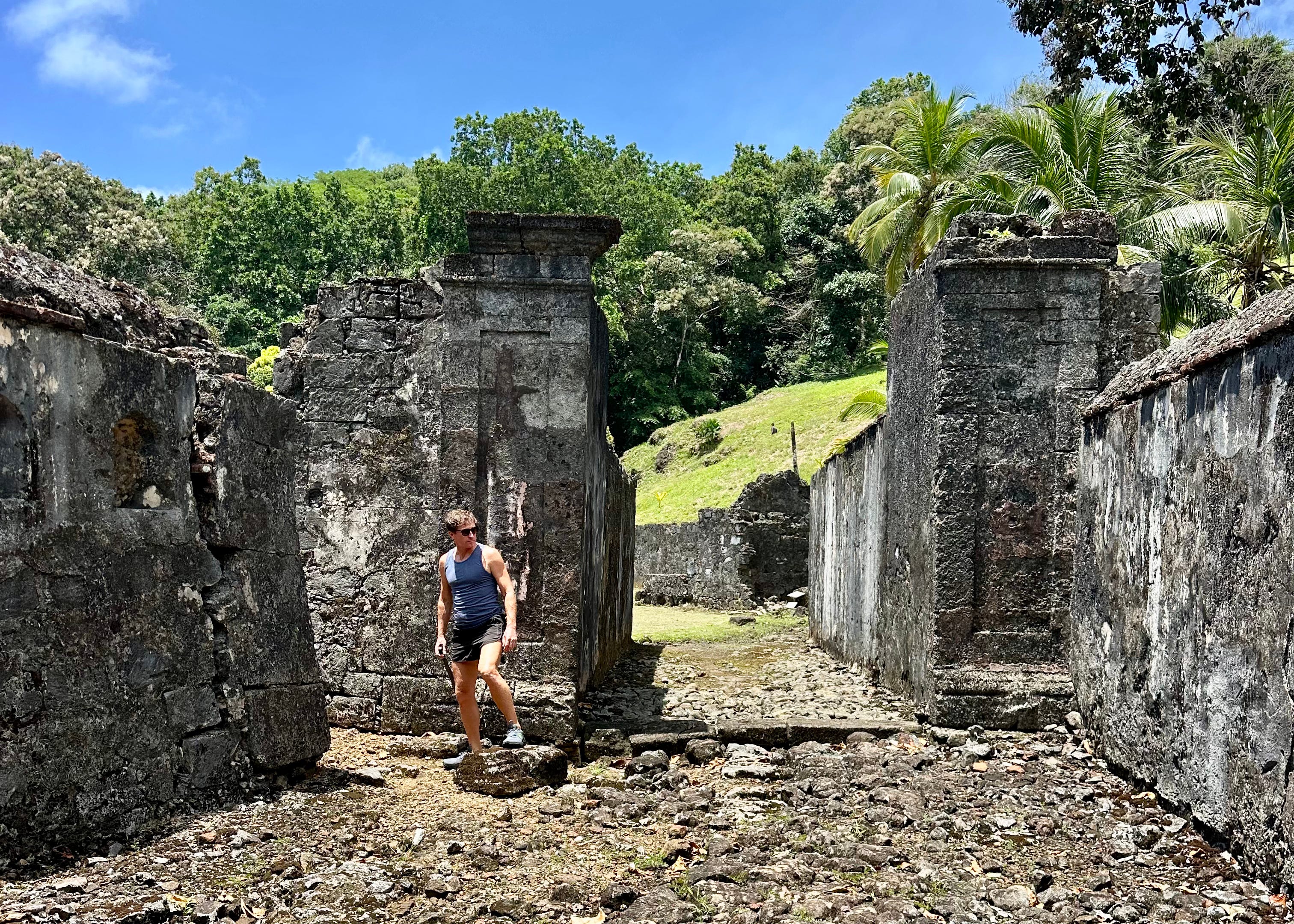
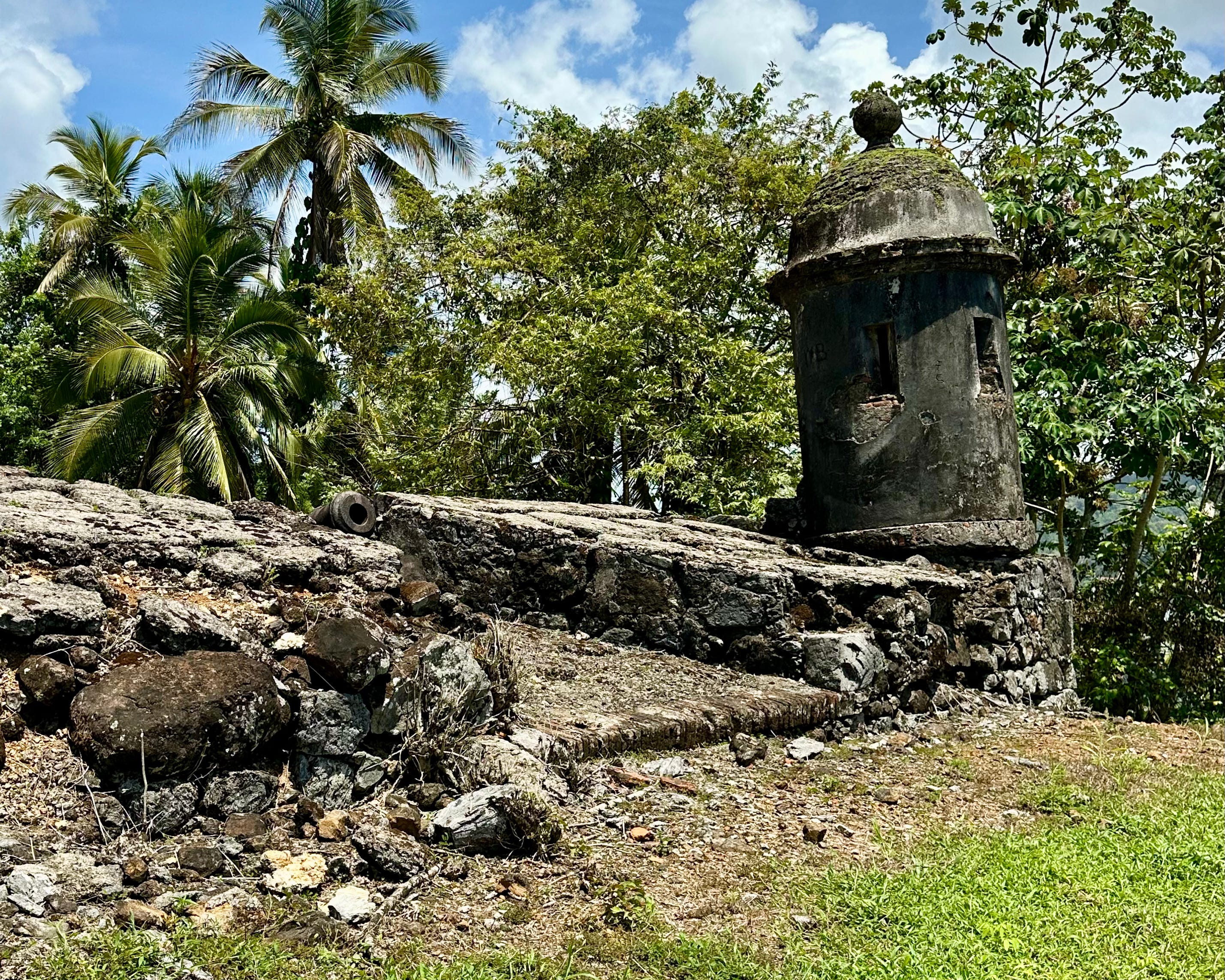
San Filipe is the lower bastion facing the water. Twenty cannons line the wall and point at our cruising fleet. A tower on each end of the battery extends over the now-dry moat. The narrow musket windows cover the circumference and every angle of attack.
I walk into the tower. The space is claustrophobic. I imagine the pirate ships pushing through the cannon fire and disgorging the brigands onto land, who then rush the hill, muskets and swords at the ready. A soldier in each tower faces the rush in panic or in battle-hardened resolve, but undoubtedly fear. How could one not feel entrapped in here? How could one stay cool, knowing they are fighting for their life, but mostly, for other people’s treasure. Soldiers then and now fighting for wealth that will never be theirs.
I feel the cold ghosts of dead troops. I rush outside.
These forts are the third iteration following two hundred years of improvements. The Spanish built the first structures in the 1590s aimed at the disorganized buccaneers. The defenses were steadily improved after successive attacks over the next hundred forty years. They deterred the pirates, but proved no match for the British, who sacked Portobelo in 1739 during the Jenkins War. It was a big win for the British; Portobelo is still a name of places and roads in England after the victory.
But the British did not stay, and the Spanish learned their lesson. They built the three surviving forts in a feat of impressive military engineering…
We leave the lower fort and climb to San Fernando. It is the second bastion directly up the hill, thirty meters higher. We clamber up the steep sides along a deep trench. It is reinforced with precisely-cut coral stone from local reefs. The coral was easy to form when fresh. It hardened as it dried but retained its absorbent quality, which was perfect to swallow the cannon balls without splintering into pieces.
The walls are still intact, oblique to the sun, but the steps have crumbled into pebbles. The coral could fight the cannon balls, but not the time under the direct tropical sun.
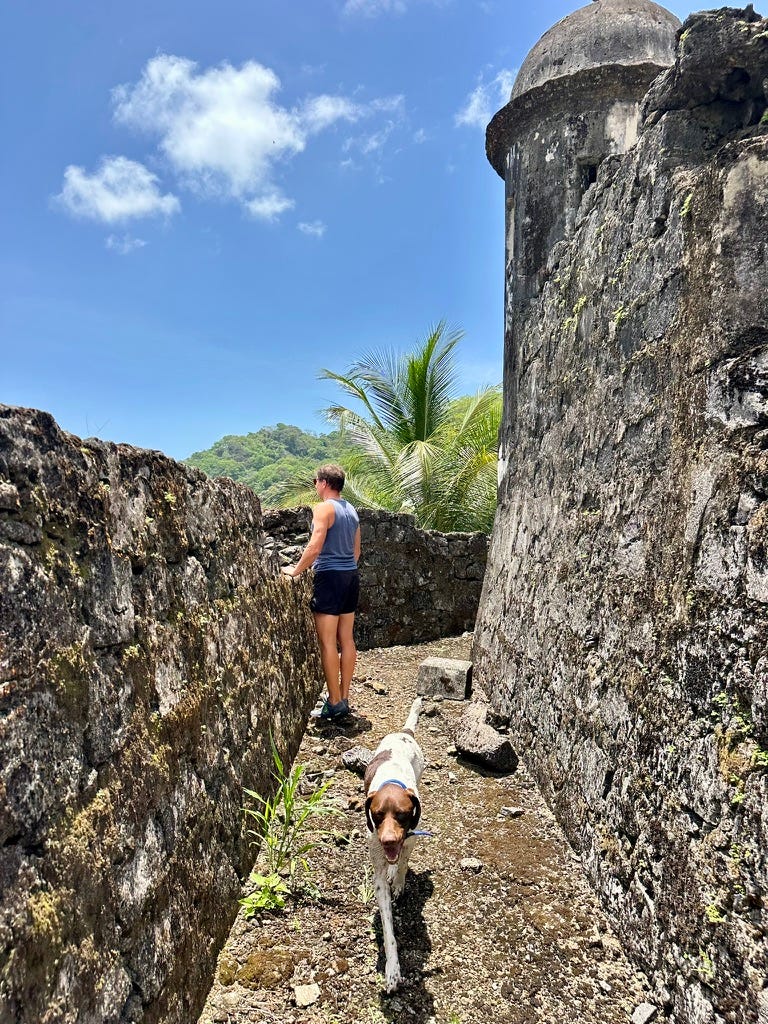
The trench is deep. I can hardly see from inside. The shorter men of previous centuries would be protected from musket fire and cannonballs flying from the sea. But it is a dubious comfort. The only retreat this place offers is an impenetrable jungle.
Up on the hill, the view is stunning. The clear waters of the bay, green hills, the whitecaps further in the ocean. Beautiful and useful. The elevation made for a longer cannon range and extended watch distance. From here, we can see the anchored container ships on the horizon, tens of miles away, awaiting their turn through the Panama Canal.
A watchman of the past saw the white square sails tacking into the wind or rounding the cape under the friendly Spanish flag, or the skull and bones banderas of the pirates, or, the most feared, the Union Jack. Each spotting broke the boredom of the garrison life and caused commotion in the ranks, and a rush of preparations for a fight. Even the Spanish flag could be a deception. No chances.
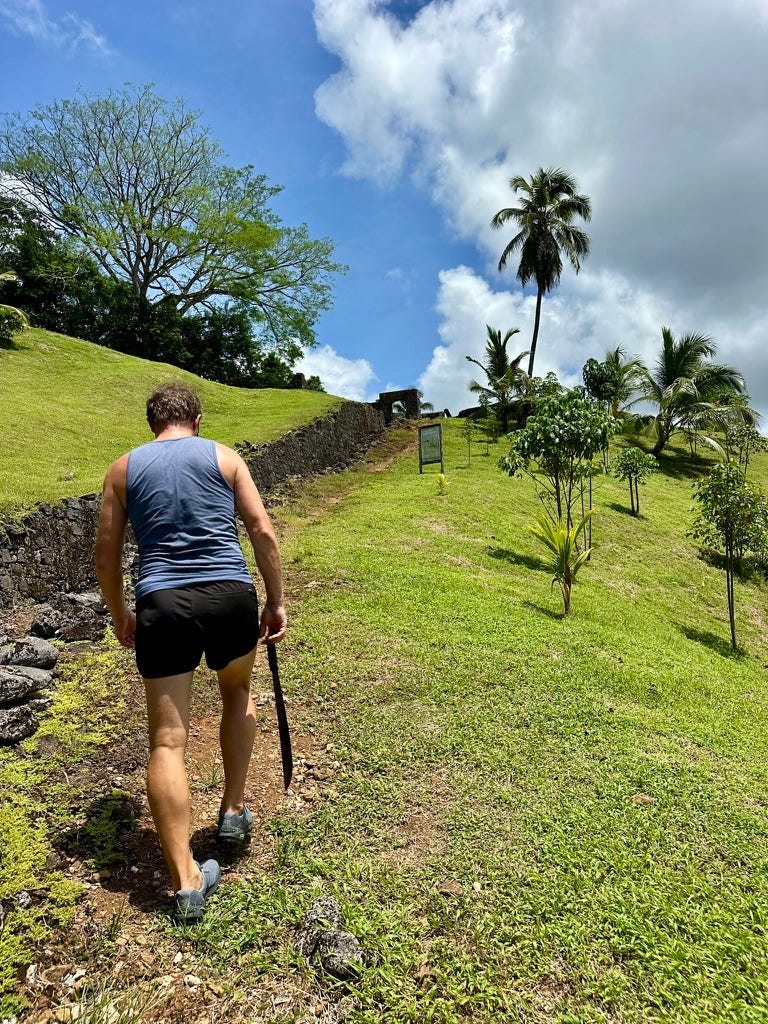
The upper fort is a smaller version of the lower. There is a stone bread oven, an enclosed latrine, a gunpowder drying room, and roofless living quarters. The rooms are mostly roofless, except two with the arched roofs in the lower fort.
What was it like living here back in those times, I ask Alex. She is sitting on the cannon looking at the fort below. Boredom year-round, except on trading days, then terror when someone unwelcome came to steal the gold, she says. No adventure? No, she says, drills, maintenance, and tropical disease. She is right, I know. I saw her read the history notes.
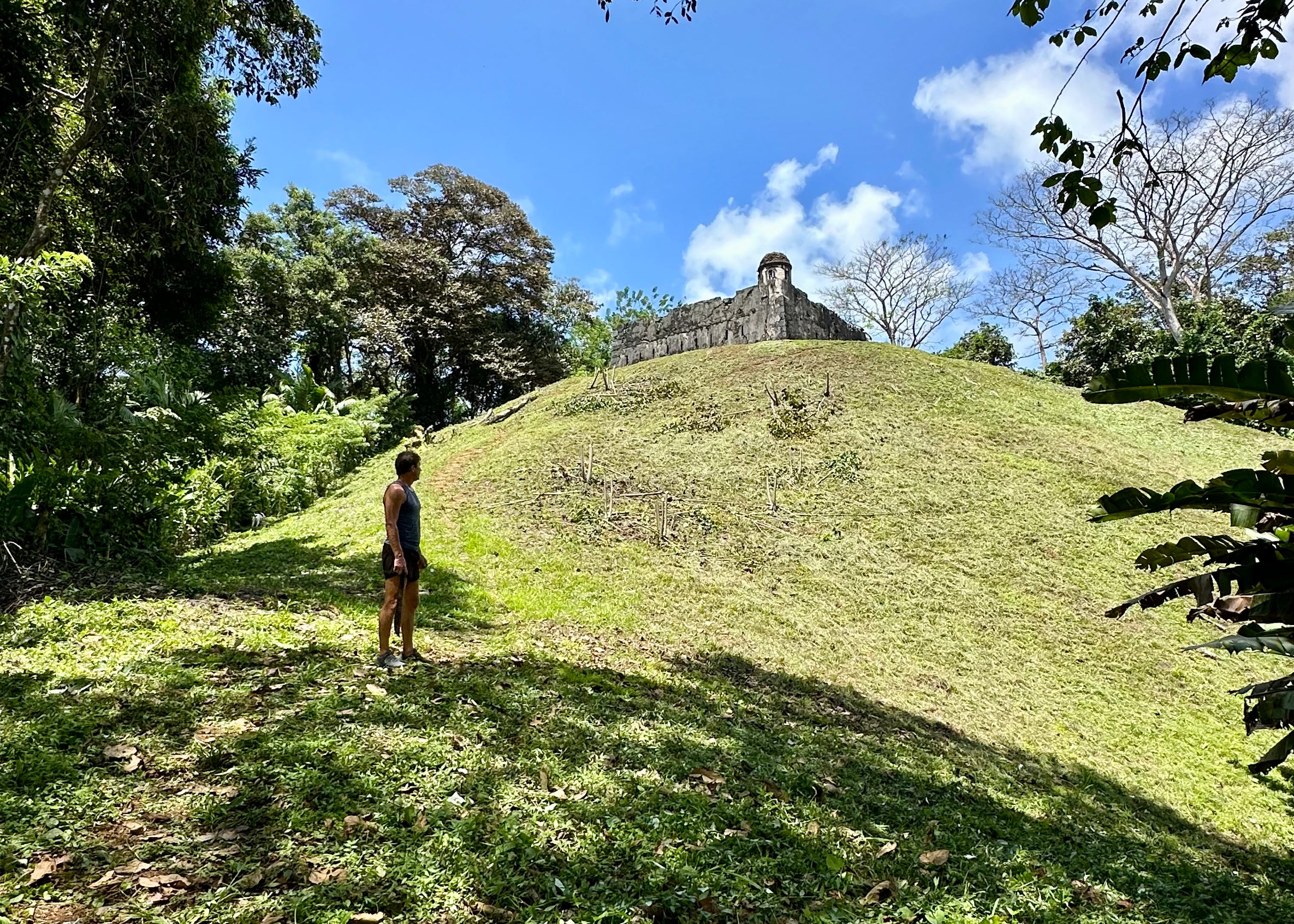
The dog explores every corner of the fort. He acts as if it is all new every time we climb up here. It is a dog’s gift. But soon he slows from the heat and trots up the path toward the jungle to wait for us in the shade of a palm. Come on, you bums.
We climb over roots and leaf-cutter ant highways. It is another quarter mile through the jungle and fifty meters up the hill. The jungle recedes, and the last structure emerges at the very top. It is a square, ten meters per side. The walls are tall and studded with narrow embrasures. Are these living quarters, or the place for the last stand?
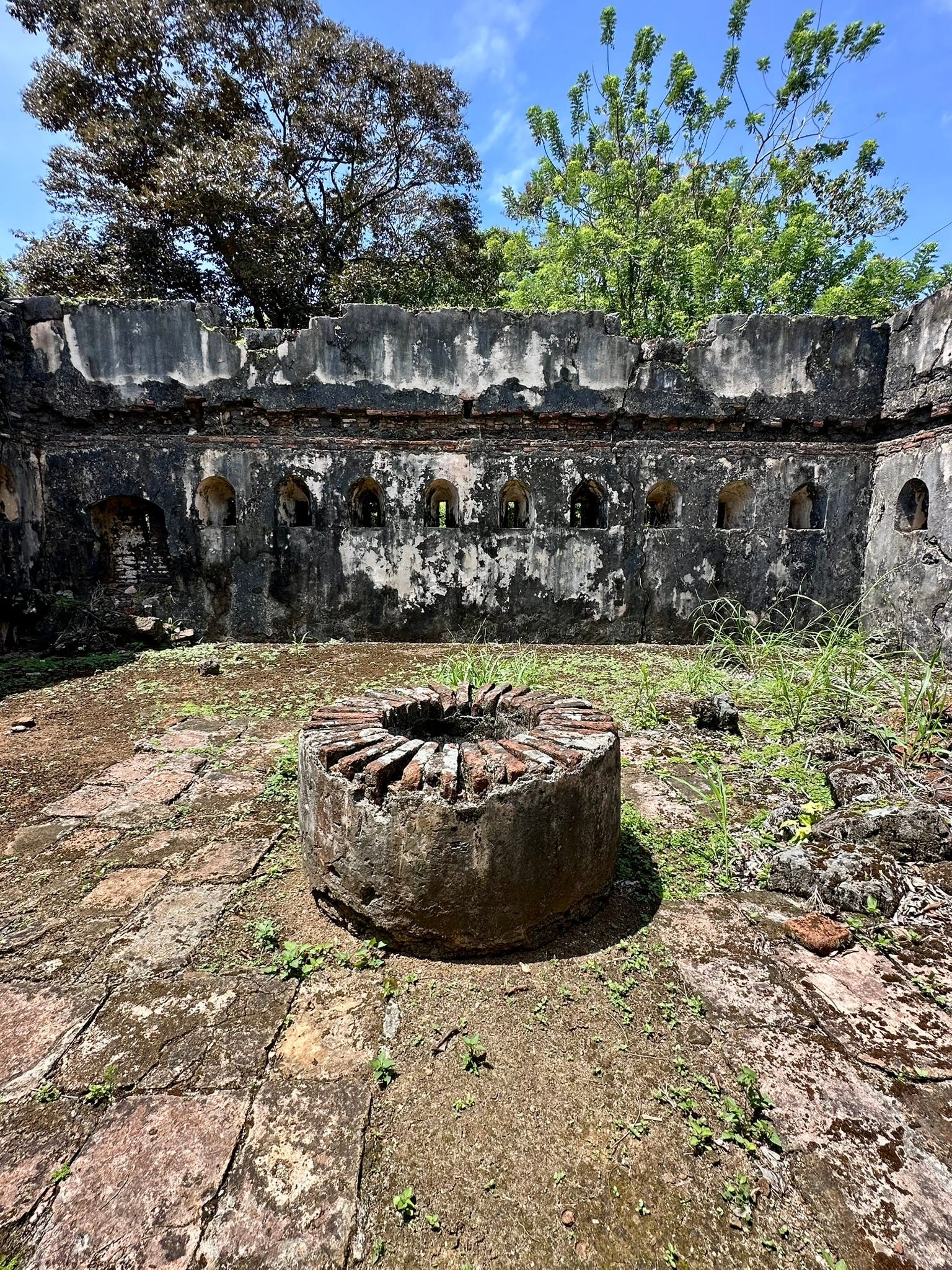
Another bread oven is inside, a water well, and coral walls. These were once smooth but are now eroded by the sun and wind. The stones look like grainy petrified wood. Pretty, really.
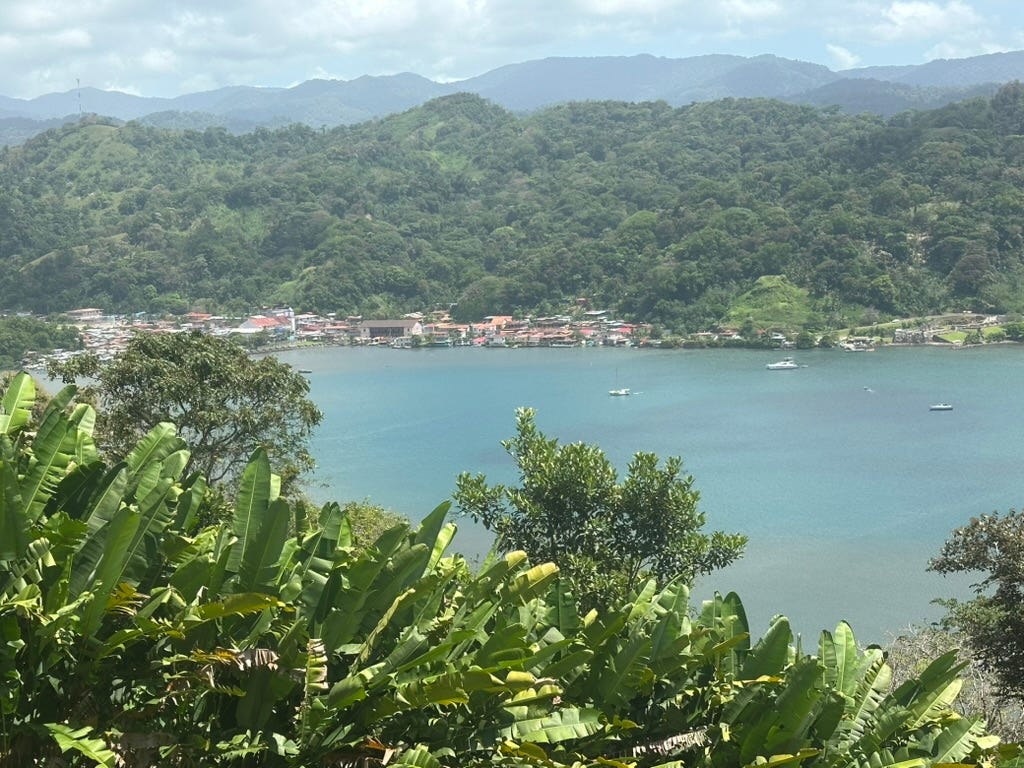
We exit and sit next to the wall on the hill facing the town. Portobelo is on the other side of the bay. From this distance, it is a happy-looking Caribbean village with colorful roofs and a chaotic street design. A postcard.
But down on the streets, it is a different picture. The walls are flaked, and the roofs are rusty. None of the gold that transited this town for two centuries has stuck. It slipped through the streets into the distant pockets of kings, queens, and merchants, as it happens with empires. But the people, on whose backs the treasure travelled, were left with none of it, but a memory of injustice. Now the bay is quiet again.
If you enjoyed this please Like and Restack. It helps us reach new readers.
I like how you approached the history of the fort, by describing it and throwing in musings of the people who defended it. Being in the tropics today is nothing like it was for soldiers hundreds of years ago. It would have been a harsh existence, hot and with risk of disease and attack.
Really nice piece Egor, about a place Ive never been and know little about. Its lovely how your writing meanders as you walk and think, like we are walkibg with you, but carries lots of interesting info - a great combination. Enjoyed it. Thx mate!🙏