


Tom was thinner than thin, his body ravaged by a disease he refused to admit. Never to me. He would sit on a bench on his walk from the breakfast cantina to his boat on the C-dock, halfway along the two hundred-foot path. Tom, you need anything, I’d ask. Nah, no, nothing. His breath short, but his voice strong. Tom, need a hand with the bag? I’d ask him the next day on our water-taxi ride from town. Got it, all good, then he’d grunt in pain on the two stairs up to the deck of his wooden catch.
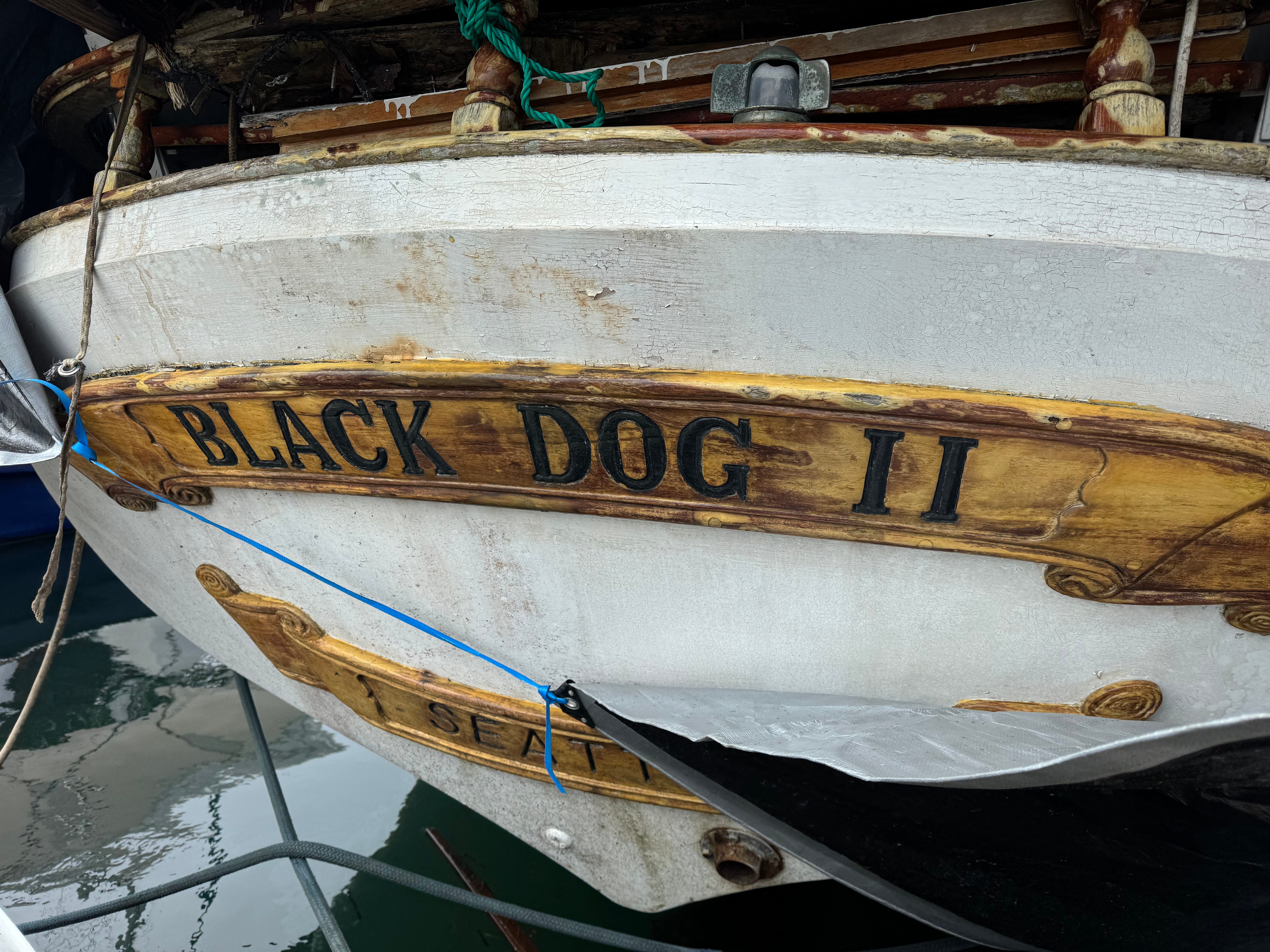
“What are you working on?” I pointed to the cuts of plywood, stacked by the stairs.
“Fixing the boat, just stuff,” he shrugged, “gotta get out of here some day.” He laughed and shook his head.
“Where would you go?”
“Don’t know, some place I’ve not been.”
“Many of those out there?”
“Oh, yeah - big world,” he said.
“Of all the places you have been, which left the most impression, Tom?” I asked.
He did not take time to think, “Patagonia.”
His boat was Black Dog. Old, once formidable and seaworthy. It was beyond the repairs of a tinkerer. It needed a liftout at a boatyard and a few expert, vigorous hands to return to service. Or it needed two hands of one man and much, much time.
I walked by Black Dog every morning. The wood of its freeboard was dry; it held its shape without visible cracks. But I could see soft spots when I looked closely. The paint was faded but not peeling. The main mast was taken down and laid along the deck. The rear mizzen mast was sawn off a few feet above the cockpit. The boat floated, but it planned to stay where it was.
“You said Patagonia last time, Tom.” I stopped and chatted with him at his resting bench.
He nodded. “We had a fly fishing camp there. With my brother. Nobody there, just trout and Patagonia. Patagonia is a character. Best time, really. A big change after the corporate world.”
“The corporate world did not agree with you?”
“Agreed with me long enough. Decades? Right? Too long ago.”
“Why did you leave? Patagonia, I mean.”
He shrugged and thought to answer, then let the answer go. “You should go there, Hank.” He smirked. He called me by the wrong name in joking retaliation for the first two weeks of my calling him John. “And the fish camp,” he added. “It is still there. Rustic and beautiful. Should see that.”
Around New Year’s, Tom was out of sight. Peter, my British sailor friend, dropped off his scuba gear for me to clean the bottom before we sailed out on a trip. “Tom died, have you heard? Went to the hospital in Davíd and stopped breathing. Nice guy.”
“No, I didn’t know. He planned on leaving, but on Black Dog.”
“Hope is good to hold on to. Nice guy.”
Tom was an acquaintance, too distant for a friend, short with words, bristling his light sarcasm as a shield against interlopers into his life. I told Alex that Tom had died, and she grew sad. She later said the news affected her deeper than she expected. Me too. Tom was in our community, now smaller.
In a few weeks, men are on Black Dog. They are feeding the anchor chains out of the lockers into a panga - the chains can be reused or resold. They are throwing lines out of the cockpit into a pile on a dock - some ropes will find a second life, most will be discarded. Two anchors are detached and stacked for a pick up by the next owner. Slowly, the boat becomes a shell, a memory. Then, maybe, a local dive shop will strip it clean, tow it to one of the coral restoration projects, and sink it. Black Dog will be an anchor to new life, for fish and corals, and for divers swimming through its cabins and imagining its history.
When life begins, we pursue knowledge. When we begin to work, we pursue possessions and experiences. When life ends, both are dispersed among the living, the possessions among family and landfills, the experiences as bits of memories among those the dead have touched.
Maybe I will dive Blackdog someday, too, but long after my trip to Patagonia. You must go there, Tom said. Insisted in a very quiet way. I thought to go before, but now I will indeed.
If you liked this piece, please Like and Restack. It makes a huge difference in helping us reach new readers. Thank you for your help!
Makes me wonder where we nomadic sailors will end up...and who will notice...the reefbuilding, shelterbuilding seems an excellent goal, really.
Tom was, I reckon, where he wanted to be. Beats so many more 'usual' options, doesn't it?
On Tilghman island here in MD there was an old Skipjack, a fishing vessel, abandoned. They eventually cut it up and put it in a dumpster to be hauled away. So unboatlike.
Patagonia? If you read recent works by Claire Polders you'll want to go even more.
As always, great writing. ~J
Oh Egor, such superb writing. The things you are experiencing along this journey are so deep, yet so "simple" - a part of life. Of course the whole subject of the story is great, but the way in which you framed it and wrote it - superb. So much to think about. Patagonia and French Polynesia are two places that still reside in my "someday" bucket. Perhaps I should learn from Tom.