

The Islands of Guna Yala
About our time here, with a short detour into history

We sailed for the San Blas Islands in the late afternoon. Around midnight, the moon rose at three-quarter strength and broke through the clouds. It lit the darkness outside the red-light bubble of the instrument panel in silver hues of old gelatin films. It released the claustrophobic hold of the night. I unclenched my jaw. I could see the storms now, had time to brace and drop the sails if a squall were to come.
Holandes Islands emerged to starboard as dark patches against the shimmering sea. No lights on land. But the lights burned behind the islands on the other sides of the reefs. Individual lights, high up atop the masts, each a sailboat. They flocked into three gaggles of a few lights each, two miles apart from each other.
They were sailing cruisers from all over the world. Couples, or families in small boats on their way somewhere or nowhere. San Blas collects them. They languish in paradise for months at a time then escape before the thunderstorms rapture the skies from June to October. Some cruisers cross the Panama Canal to sail to Polynesia. Others work their way back to Europe. A few go to Columbia, or Bocas Del Toro, to wait out the storms, then come back for another season among the palm islands.
After a day at sea, I wanted the peace of the anchorage. I zoomed in the chart and searched for an easy passage inside. But green jagged contours of reefs formed an impenetrable wall on the charts between us and the lights of the boats. The reef ran for another three miles East, then slowly bent South towards Panama.
The back side of it was a minefield of coral patches and heads. I read the warnings of uncharted rocks that could puncture a hull and grind your boat into wreckage. And of uncharted shallows to beach you like a hapless whale. “Approach in good light only,” the warnings said.
The sun would not rise for another five hours. The moon alone was not enough.
I shook my head. Alex and I discussed this before the passage. We would not go into anchorages here at night. Too dangerous. But I was alone on watch and tired. The siren song of calm anchor lights tempted me in their direction.
This was our fourth year of sailing life. 15,000 nautical miles of passages, shoals, and inlets without a catastrophe. We were careful. We made plans to minimize risks, and stuck to them to avoid temptations. The sea tests your safety margins, and when you don’t leave any, it wrecks you in punishment.
The plan was for Coco Banderas, still some hours away. I watched the lights recede.
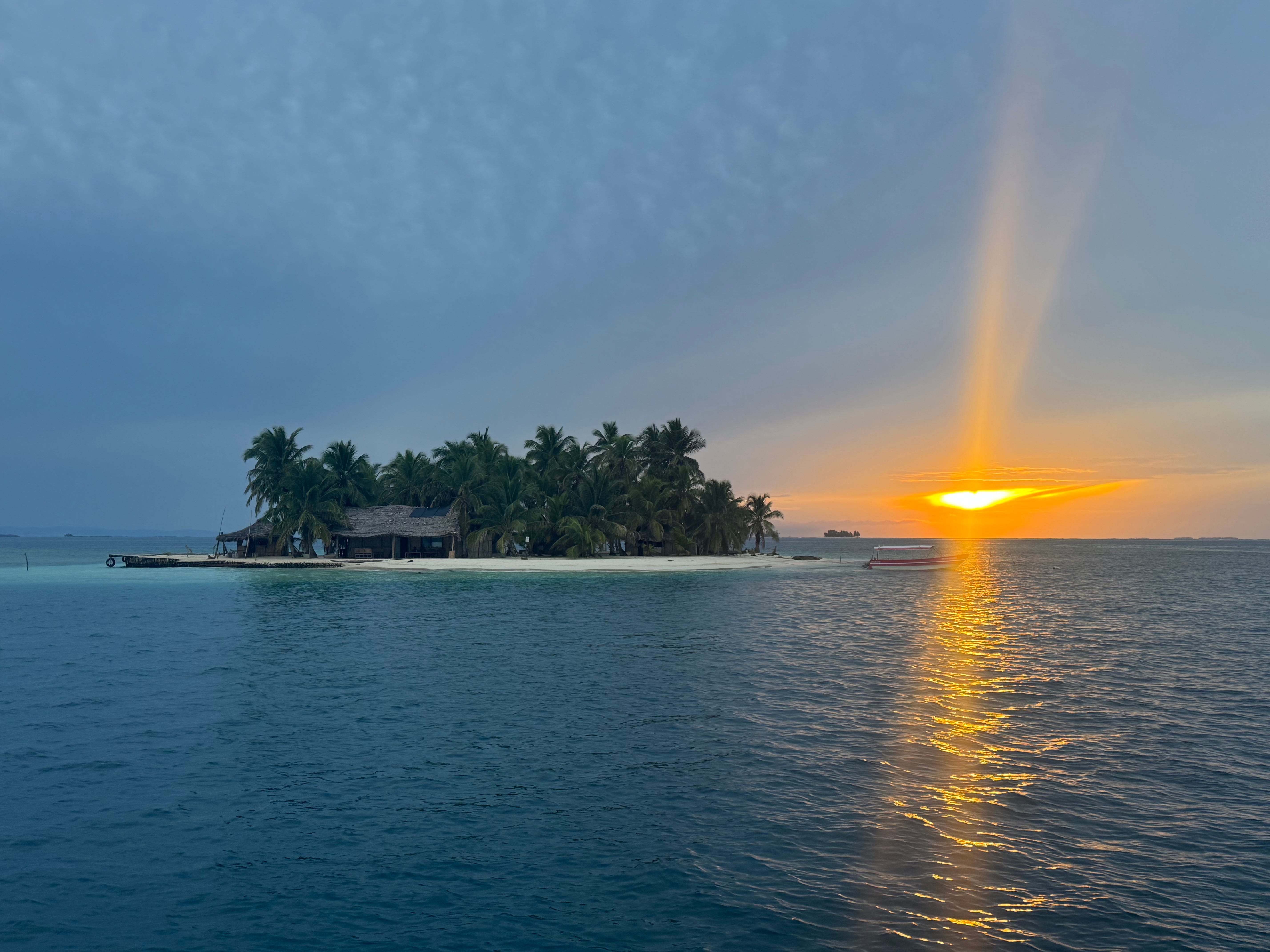
The islands are a postcard paradise. Clear water, soft sand, and palm trees in the breeze - the cliché dream of the stressed masses. But San Blas is without crowds that plague the white sands elsewhere. Here are no hordes among the forests of beach umbrellas and umbrella drinks. These islands in Guna Yala are remote. The beaches are empty.
The archipelago of Guna Yala is known to the westerners as San Blas. Columbus likely named the islands, bestowing a name of a saint Saint Blaise or San Blas in Spanish. He came through here on his fourth voyage in 1502 and charted the islands for the Spanish crown. He did not stay. He meandered along the Panamanian coast, fixed his ships, re-provisioned, and went on to meet a disaster in Cuba. He lost a ship there, and later the favor of the queen.
The islands are north of the Darien and its infamous migration route, along the north-east Caribbean shore of Panama. You can see the mainland mountains from the islands, jungle-covered, layered, and steep; except when the air is thick with humidity and turns the mountains into faint blue outlines; or when the thunderstorms absorb the peaks and replace them with billowing white towers growing into anvil heads.
San Blas islands resisted interlopers for millennia. At first, the indigenous Guna people avoided them too. They stuck to mainland with its sources of fresh water and fertile land. They used the islands for fishing and as transportation points along the coast. Guna moved to the islands later, when the pressure of the European conquest pushed them away from their traditional mainland lands.
First it was the Spaniards, who came for gold and glory. But the treasure they found was in Peru, on the other, Pacific side of the Panamanian isthmus. Darien mountains and jungle proved impassable to a caravan of treasure wagons. So Spanish shifted their activities to the narrowest part of the land, to a route between Colón and Panama City, along the path of modern Panama Canal.
The pirates moved in instead. San Blas was just far enough from the reach of Spanish navy but convenient for launching raids against the galleons. English navy came next. They spent much time competing with the pirates for the Spanish treasure, but with a mandate of a government which recast stealing into a righteous cause.
Then came the Scots. In late seventeenth century they established New Caledonia, a far flung colony in Darien. The hardy Scots could handle the cold of their land but not the heat and tropical disease of Panama. Thousands died. The adventure was so expensive for the Scots, that some argue for it as one of the reasons the beleaguered Scotland joined with England in 1707 in the Act of the Union.
Empires came and went, and the Guna people lived through them all. They were part of Spain, then Colombia, then Panama, through rebellions, revolutions, and early twentieth century U.S. gun boat diplomacy. Always apart with their unique culture and independence.
In the early twentieth century, the Panamanian government embarked on a new reconquest of Guna Yala region with a campaign of forced assimilation and erasure of local customs. Guna rebelled in 1925 and gained autonomy and local control, which they still exercise today.
To me, this place is a fulfillment of a childhood dream. I grew up on books of Jules Verne. The grand adventures at sea, the daily chores of climbing the rigging and setting sails on tall ships. Fighting the pirates. Or being a pirate and fighting a tyrannical king.
The adult version of the dream is of a different flavor, more modest, less romantic. More satisfying. It is a gift from a corporate world, in which I served a twenty year sentence for committing a crime of being born with ambition. But it released me with a modest backpay, after serving my time, albeit on parole, where I still have to show up and work, although from a nicer office.
We came to San Blas for a month. Then stayed for two. Then three.
A blue thirty-foot panga brought veggies and fruit once a week from a tienda on Esnasdup. The produce sat in green milk crates placed side-by-side the length of the boat. One man hopped between crates grabbing items we named from our boat. The second man weighed each new addition, and called out the number to the third who scribbled on the notepad the results of his mental arithmetic. Then we paid in cash and they left but not without shouting the schedule of the planned return.
The small motorized cayucos of the mola sellers, long and narrow, stopped by each week. People from Rio Azucar, or Nargana, or Ticantiqui. Each time a different woman in a traditional mola dress, arm and ankle bracelets showed the handcrafted, layered fabrics with geometric and animal designs. They kept the molas dry in plastic bins for transit, then pulled them out and laid them on their lap, showing and stacking one upon the other. Beautiful. They looked painstaking to make. We bought several over a few visits as gifts for friends, but soon, we had to say no in an awkward exchange of their solicitations and our apologies.
Fishermen buzzed by at least once a day. They stood in a boat and held a large mutton snapper or a jack. We waved them in at times to buy the fish and to keep things cozy with the locals.
A few days ago, I made coffee at 5:50 in the morning, when the sun rose and woke me. I went up on deck and watched two fishermen dive with spears on a reef in front of us. They pulled a few lobsters then took a break in their dugout cayuco, the same cayuco design as from a few hundred years ago. How they fished was the same too. The scene looked stuck in time and beautiful. Tranquil.
Then, they opened the plastic zip loc bags and lifted their phones. Three miles from mainland, six hours from a city, but there was still signal.
Here, the tradition is colliding with the onslaught of smart phones and cheap information. The youngsters like the content of distant TikTok influencers, and watch the YouTube shorts with dreams of their own travel, but then fish and work on fincas just as their grandparents did at their age. The elders cling to old ways, and traditional clothes, but call-up the inter-island Communal Congreso meetings on WhatsApp.
How will this dichotomy of old ways and new pressures resolve in their community? That is what I thought when I drank the coffee. But I arrived nowhere. I suspect they don’t know too. Maybe they will fight the modernity in the way they fought the Spanish, then the Scots, then the Panamanian government. They outlasted and out-willed the interlopers to live by their own traditions. But modernity is not a temporary conqueror. It is not a flooding and ebbing tide but an entire change of the ocean. A sea level rise. Relentless and certain. Fighting it will only make you drown. The phones are here. They are the window to another reality beyond the words of the elders. The tradition is still here too, but slowly mixed with the catchy tunes of the reels.
Maybe the modernity will not condemn Guna culture to erasure. Guna outlasted the past challengers. They adopted and synthesized, yet always kept their core. Today is another chapter of their story of resilience which, I hope, will continue onto the next generation.
Loved the history of this special place.