


Logbooks are short, unpolished entires about curious things we see while we are actively traveling.
I would have dismissed it if only one boat with a swastika flag passed us by. But two? What are we sailing toward?
The flag is the two thin red stripes at the top and bottom. A thick yellow stripe is in the middle. The thin lines of the black swastika are in the yellow center. The swastika shape is unmistakable, yet it is inverted as if seen in the mirror.
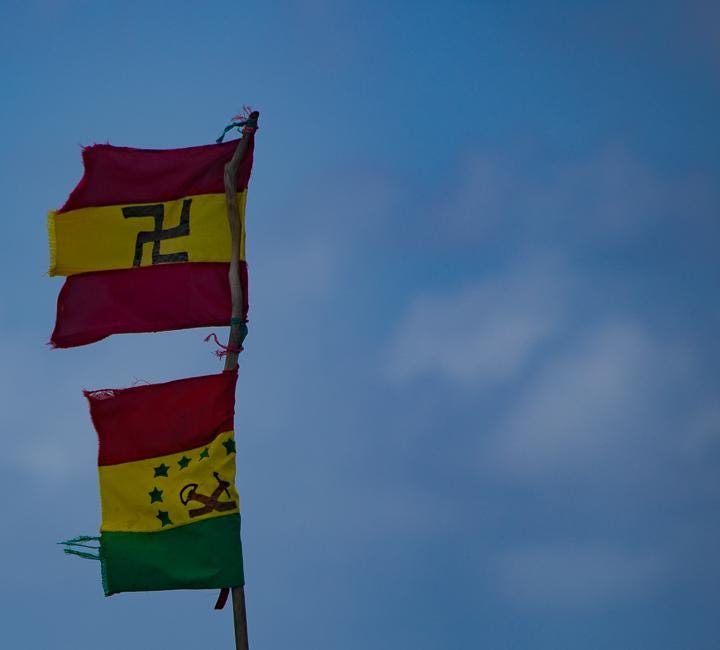
I grew up in the Soviet Union. My childhood was filled with the mythology of fighting the Nazi’s. It was a devastating and real fight for most families, as everyone lost someone in that war.
Twenty million dead.
I felt the anguish and hardship of it through my grandparents’ stories. The swastika is a symbol that triggers instinctive dread.
In truth, we expected the flags. And fortunately, they are not what they could mean elsewhere.
We are sailing into the Guna Yala archipelago, more commonly known as San Blas in English. Alex had read the regulations, as she does, before we landed on the islands. Although a part of Panama, the islands are administered by the local indigenous tribes, Guna Yala. Panama designates “comarcas” where indigenous locals have a degree of control over rules, access, and income. One of the rules in Guna Yala is that every yacht, or a small sailboat, must fly the flag of the region.
I love that rule. They are called courtesy flags, and each yacht must hoist a small flag of each new country it enters upon clearing customs. At least, while the yacht is within the borders. We have a bag of them. Hoisting a flag for a people who have lived on these islands since before the Roman Empire feels like a small act of justice.
But a swastika?
I understand that the symbol found its origins in mythologies preceding Western civilization. Archeologists found it on pieces of pottery 10,000 years old. In India, it was a symbol of luck and a cosmic order. In Buddhist and Jain traditions, it signaled the eternal cycle of life. In Guna mythology, and other Native American cultures, it meant the four corners of the world, the symbol of the octopus, and the cosmic structure in balance.
It was on the Guna flag before the Nazis adopted it as their symbol of murder. I just can’t shake the instinctive reluctance to fly a flag with it.
But in the nineties, the Guna dropped the swastika from the flag in favor of a new design. Green, yellow, and green. The interlocked arms of solidarity. The stars of the seven Panamanian tribes. It is beautiful.
Yet, the bad news is that they had to change it. The pressure from the world pushed them to abandon the symbol connected to their history, because a bunch of assholes elsewhere made it evil.
Or, should I abandon my Eurocentric lens? Respect the local history and local choices without judging them against my hurt sensibilities? Maybe.
The next time we see a local panga selling goods, I will ask for the original flag. If they have it, I may hoist it to honor their history and to spit in the face of the Nazis. Deny them the the ownership of something ancient.
Indigenous people around the world and past antiquity have used that symbol. It’s past time we quit worrying about the evil ones and start respecting the true history. Hope you found one