

Logbook: Indigenous Kuna Village
We visit a small island village where everyone has a vote

Short dispatches from our travels in less than 800 words.
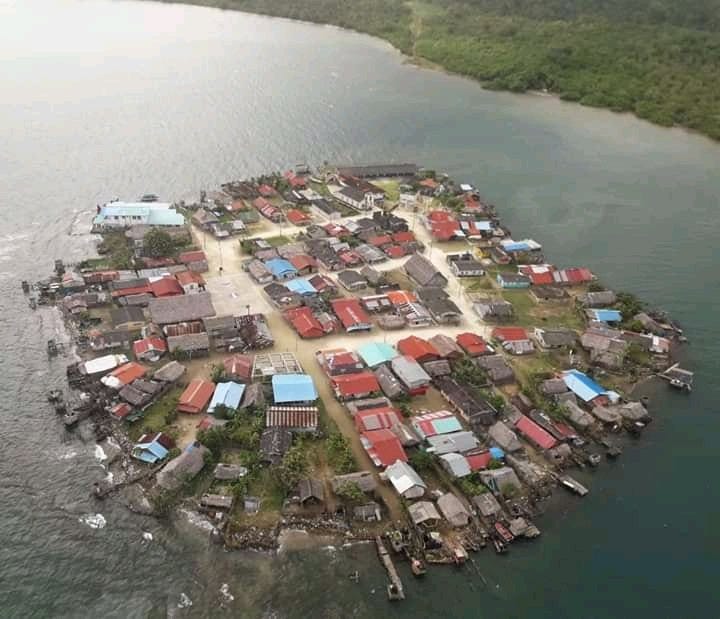
Rio Azucar - Sugar River - is an indigenous Kuna village. It sits on an island, disconnected from the mainland by a small strait. We see a collection of thatched roofs from our solitary anchorage, and a sparse field of lights at night. The island is tiny, a few football fields in area, yet the map shows a bakery, a store, a school, and a small medical center.
We pull up to a small concrete dock. A Kuna woman, with a notebook in her hand, walks around as if expecting boats. It is only us. She says nothing as we tie up our dinghy. I nod at her, and her eyes dart to her notebook. She writes something, glances at me, then dashes to a shack.
A wiry man waves and walks over. I am Monolo, he says. What are you looking for? It is not a challenge but a welcome. He wears long pants, flip-flops, and a polo shirt with black and white stripes. He is just over five feet, which is a common height for Kuna elders. The younger generation trends taller. His hair is long. I notice some grey.
We are here for veggies and bread. He waves us to follow him on a path between tiny homes. This is the Main Street, as it were.
The place is remarkably clean. In the villages on the mainland, we grew accustomed to ditches with plastic bottles, torn paper plates, and pieces of used clothing. Just enough to leave a polluted memory. Here, the dirt path is raked, grass trimmed, nothing is stacked outside the homes.
Only children are playing, and their mothers on stools.
The homes are made of cane stocks, stacked vertically, tightly packed, and cross-hatched with palm leaves. The roofs are thatched or tin. Two windows per wall are cut in the cane. The windows are covered with a piece of fabric attached at the top. The fabric sways with the wind.
The homes surround a square. Two poles with Kuna flags mark the entrance to a pavilion. It is also made of cane with a thatched roof, but is large enough to cover a tennis court.
Congreso, Monolo points to it. Each Monday and Wednesday, the village gathers here, and we make decisions.
Which decision?
All decisions. About life in the village today and tomorrow.
How do you make them?
We talk, and we vote.
Everyone?
Everyone - women and men - equal rights, one vote each.
What was the last decision you made?
Where to send kids to high school. When we have money, we send some to Panama City. When we don’t, we send them closer to home. Two kids are going to Panama City now.
At the small store, we buy zucchini, tomatoes, Balboa beer. A woman who checks us out has only one eye, but no patch. A younger woman with bright teeth packs our groceries. She is Monolo’s daughter. The other is his wife.
We walk to the bakery and buy fifteen rolls, one dollar and seventy-five cents for all. I pull a roll from a bag, shake off an errant ant, and bite into it. Sweet coconut bread.
This is the clinic, Monolo points to a two-story stone structure. Always a doctor here from Panama for the villages. They come on rotation. The building has glass windows, a set of modern doors, and a waiting bench outside. When Obama was president, Monolo says, America helped us build it. Obama - yeah! Monolo brings two thumbs up.
And Trump?
Loco, peligroso, enojado - crazy, dangerous, angry. Obama - good person, the first thing he says in English.
We walk by the school, a single-story stone building with a painted brick fence. It is larger than I expected. The school is only through the eighth grade, Monolo says, then the kids go away. Do they come back? Most do, a few don’t. Loud city life is not for everyone, quiet life is not for everyone, too. But they come back. This is a good life. He waves around.
We are back at the pier. The woman with the notebook smiles at us. She says something to Monolo in the Kuna language. He says yes in Spanish, and she dashes to the guard shack. We buy avocados from Monolo’s brother, who just docked in a panga. Then he loads our bag with limes. Regalo, regalo - gift, he says. We run into such gifts here. It is a bizarre reversal of tipping.
As we pull away from the pier, Monolo yells, “We have a veggie boat. Kaidel is the man. He will find you.”
“Blue boat?” I holler.
Monolo nods. Si, Si. I raise my thumbs in the air.
If you like this logbook post, please consider Restacking - it helps us to reach new readers.
What a pleasant island. I'm sure it's not easy to resist becoming a tourist spectacle with the possible revenue, but these inhabitants seem to be doing the right thing. I was in the San Blas islands many years ago (also Kuna), and it was similar, but I have no idea how they would be today.
So interesting. When I scroll the google maps for Guna Yala Comarca, I get an impression of a handful of village-islands like this, fully covered by housing, mostly on the open sea, and then the coast which seem to be completely uninhabitted, covered by forest with no villages or roads. Is it really like this? Why isn't anyone building on the coast? How do they survive cyclones in this tiny island surrounded by water?