

Logbook: Burn Sites on the Map
How trash is handled on remote islands where there is no system

Short dispatches from our current travels through remote islands in less than 800 words.
Think of this. One day, the garbage trucks stop coming to pick up trash. The city dump is permanently closed and walled off. But you still buy groceries, eat, and shop on Amazon. What happens when garbage bags stack up outside your door?
That is my problem today. Two bags are up on deck, their drawstrings tied. But there is no garbage pickup on the islands of Guna Yala.
Instead, on our maps of the archipelago are green icons for the burn sites. One every few islands. The sites are there by consensus, and because someone added the spot to the map. No government was involved.
We take our dinghy to the island, collect the fallen palm fronds and driftwood, pile them high, and light it. We throw the trash into the flame, then watch it burn and melt. The fire must be hot enough to incinerate everything, leaving only ash.
I like campfires. It was my favorite activity in childhood, and later, when breaking away from my concrete office to camp. But burning trash is a burden. I cringe watching the smoke pollute the sky. But it is not floating in the sea.
This problem of disposal throttled our consumption. We catch our own fish. We buy fruits and veggies by handfuls from the boats that arrive from the mainland.
But trash bags still fill. The provisions leave empty cans and wrappers. Our resupplies from PriceMart (Panamanian Costco) arrive overpackaged in layers of cellophane. Parts shipments come in two cardboard boxes.
We consolidate orders and think them through. Or, we choose not to buy. We generate only one small bag of garbage every two weeks. Astounding, in comparison to a full trash bin I rolled to the street side weekly in my previous city life. Astounding, I thought I needed that much.
The islands are clean of the local trash. Mostly. Once in a while, we see a bag that someone left against a tree without burning. They sailed away, so it is no longer their problem. It is only one bag, right?
Yet, the islands are full of trash. When we walk beaches on the ocean sides of the outer islands, the highest tide mark is littered with plastic bottles, a collection of single shoes from old pairs, and empty jugs of bleach. The surviving instructions on the jugs are in English, Spanish, Portuguese, Chinese. From where did they come?
In the mid-1800s, Matthew Fontaine Maury, an American naval officer and oceanographer, convinced ship captains all around the world to drop bottles into the sea, with a message inside to anyone who finds one, to mail back the location and date of when they have found the bottle. His enormous experiment mapped how ocean currents moved around the world. The charts tell the story of the trash I see when walking around my remote island.
Today, we could simplify Maury’s experiment by walking on the beach with a grocery store scanner. Scan a plastic jug of bleach, or an empty pint of 15W-40 engine oil. In a data center somewhere is a record of where the items were sold.
Now back to our trash. I’ll admit to a weakness: we like beer. It is in light and crushable aluminum cans, but unburnable. Two beers a day fill a bagful in four weeks. When the bag is full, we set sail towards the mainland, where a local - J - lives in a small shack on an island the size of a football field. He collects cans and takes them for recycling on the mainland. He is paid for the cans by weight.
There are other enterprising locals who charge two dollars for a bag of cans. Later you may see the bag in the mangroves of the next island. No bueno. But J does not make you pay. He has to turn the cans in to make the money.
We sail to his island group. Our trip is not only to drop off the recycling. A family restaurant caters to tourists there who arrive in pangas for a day on the San Blas islands. We crave their chicken after weeks of seafood.
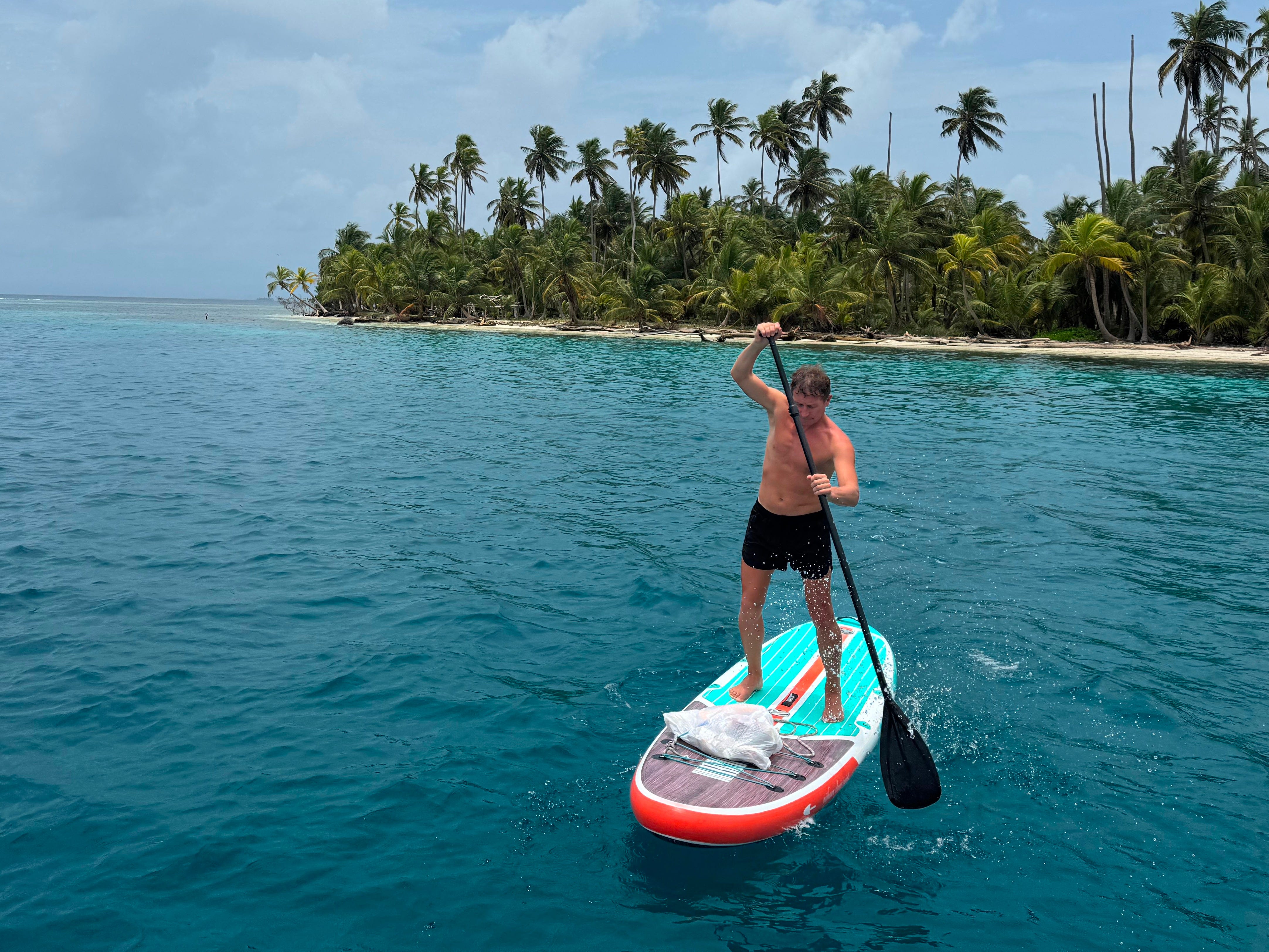
In the morning, I secure a bag of beer cans under the straps of my paddleboard. And another bag of tin cans. I aim at the palms on the other side of the reef, half-mile downwind. I hope J is home to take my cans, so I don’t have to push my inflatable recycling barge back into the wind without dropping its cargo. J is there. I am happy he will make a little cash.
If you liked this story, please Like and Restack. It help a lot with reaching new readers. Thank you!
A beautiful problem to have, eh? No trash trucks rolling around. A lot of cruising to me is making sure to pay enough attention to local resources like J so that you can make less impact, or in this case even a (sortof) positive one. Some of our used oil will get fires hot enough for aluminum but not tin. In the Bahamas the dumps burn their trash each week, sending huge plumes in the air......
I am so missing my cruising days. !! I'd trade you lots of chicken for some fresh lobsta. Cheers to you beer lovers. ~J