


This essay is about places that feel complete—and why leaving them, temporarily, may be the only way to truly stay.
“When are you planning on leaving?” Our friend asks over a beer. “We planned for early November,” we say, “but projects got in the way - so three to four weeks from now.”
Christmas is in a few days. We are indeed late. “You are not going anywhere,” he laughs kindly and dismisses the idea with a wave. It is a welcome to the club.
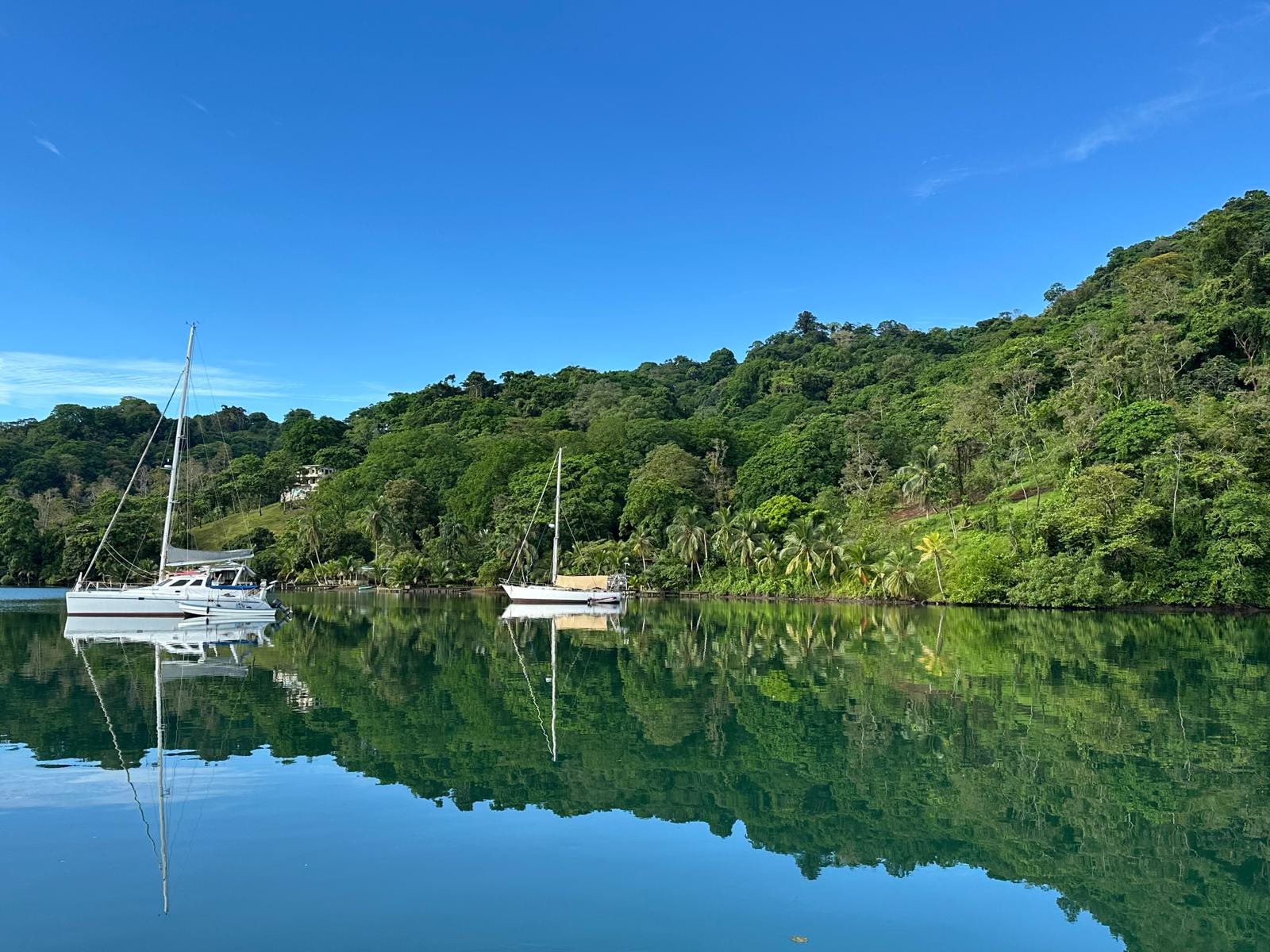
It is true for many. People pass through this place on their quest to see the world, then see something they like. They linger for another week, or another short project. They don’t decide to stay, only decide not to leave today. Soon, they plant roots in a community of friends. And why not? If a place resonates and captures you, what is the need to move on?
We ask ourselves that often after a tough bout of travel. Tired of change, exhausted by sailing weather, and the bureaucracy of customs, we crave the routine of one place. For a bit, until the restlessness of familiarity creeps back in, or an urge to meet a new culture. But in this place, among the islands of Bocas, the urge to move is less acute.
It is an age-old story, beginning at the time of early human tribes. A tribe settles and grows. It forms hierarchies, and soon enough, a restless band of youth picks up their kin and travels to find another home, where the luck is their own to make, unrestricted by the settled order of a prior home. They build a village, survive or thrive, but soon enough, they spawn another party searching for their own luck.
Their move is an act of convenience, or necessity, or rebellion, but always of renewal. Their restlessness is not a flaw but a feature of humanity that seeks to expand the horizon of what it knows and what it can do. This impetus has grown in us through evolutionary imperative.
Yet, breaking the magnetism of a birthplace is a monumental effort. It is easier now, less permanent, with planes, trains, and automobiles to shuffle us back to see the family and friends. Still an effort to go and form new bonds, establish yourself in a network of people often wary of outsiders. Most people I came across never do it. They never leave. Some out of fear. Others, out of faux-wisdom that new places bring nothing new. They say that new places, like all people, are the same.
Others leave and return. In the time away, they gain the deeper wisdom that transformation is possible without leaving—but only with an attention to nuance impossible to gain without departure from the place you know. A paradox, but true.
Our home never urged us to leave. But we are a part of a narrow band of human nomads who want to see what else is there, at the expense of the predictable comfort of an established life. A need to shake assumptions and shed the boredom of agreeable thinking. Travelers we met here share a similar urge. Why had so many stayed?
“I came on a sabbatical eight years ago,” an American woman in a taxi tells us. She cradles a dog too big for her lap. The back seat of the Toyota Hilux is too small for three people and a pet. Her now husband is in the front seat, a local, speaking Guari-Guari with the driver. “This place just makes sense for me. Slower, with less pressure from the clock.”
“You think you will ever go back?” I ask.
“I go back to visit, but it only reminds me to return to the island.” She looks outside at the surf lapping the beach, next to the dirt road, bouncing our pickup on its potholes.
The story is especially common with sailors. Panama is at a unique crossroads for big decisions. From here, a sailor can pass through the Panama Canal into the Pacific and commit to a journey around the world, or at least to a month-long passage to French Polynesian islands. It is a gigantic choice.
The other option is to sail another loop of the Caribbean Sea along the Antilles and the islands north of South America. But the journey requires beating against the elements along the Thorny Passage, named well to reflect the sting of trade winds pushing against the sailors’ will.
It is easier to delay the decision and to stay put. Soon their boats grow oysters on the bottom, barnacles foul their propellers, and jam their rudders. Years pass, and these sailors finally admit that the anchorage or the marina is their end of the road. They shrug and acquiesce to their fate. “I guess I am stuck in paradise,” they could look around and say, but most of them don’t, because they surrendered their option to leave. And the place that does not offer a door out is only a prison with a view.
We are not staying. I feel this place could be a home. I love it. I am learning to treasure what it offers. And that is precisely why we will move on to Colombia, Guatemala, and Roatán. We need the challenge of the sea and a look into the new cultures, to feel the freshness of the familiar place upon return.
“Is it normal for the snow to be gone from the mountain so early in May?” I asked a friend a few years back when I visited him in the mountains. He looked out of the window and shrugged. “I have not noticed,” he said. He moved to the mountains exactly because they were there, then he forgot to see them.
We will sail away to remember what we found, and to notice it again upon return.
If you liked what you read, please help us reach new readers - Like and Restack. Thank you!!
I meet people who get stuck like those you describe. figurative encrustations on their hulls that hamper their ability to move on. I also notice that those individuals become deeply entrenched in routine, often a very simple one. It never looked enticing.